

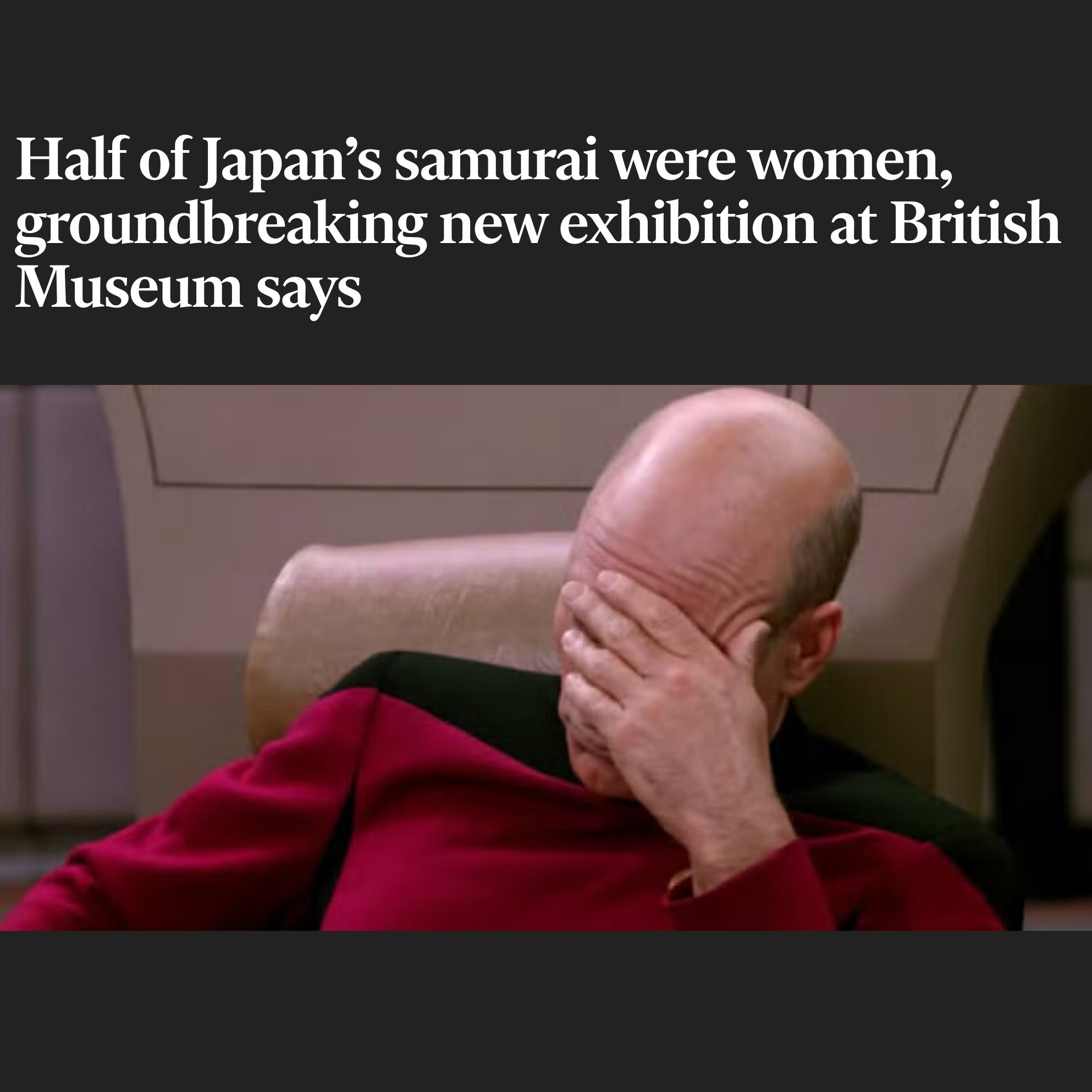
Hyping up something is fine, especially if that something is a museum exhibition, but sometimes hype turns into falsehood.
Someone sent me this article from The Independent with an eye-catching headline:
Half of Japan’s samurai were women, groundbreaking new exhibition at British Museum says”
Oookay. Mr. Independent here is being a tad cheeky with his words. This sentence stands right at the edge of misleading, then absolutely falls down that cliff.
To most people, “samurai” were those badass Japanese guys in armor with swords who kill themselves from dishonor the moment they drip tea on their lord’s sandals. You mean to tell me half of them were badass women instead? Nice, nice. I’d watch that anime.
But wait. We’re not “most people,” you and I. We know that being a samurai was not a job. You didn’t just put on some armor, walk into a battlefield, and get called a samurai. It was a hereditary social class. People usually became samurai by being born into a samurai family.
Knowing this, the exhibition doesn’t seem that groundbreaking. The ground is quite still. Half the people in samurai families were women? You don’t say.
If you look in the article, it clarifies:
The samurai emerged in the early medieval period in the 1100s to 1600 as wealthy households hired warriors for private security provision.
The mercenary group developed into a rural gentry and by 1615 they had moved away from the battlefield to serve as government officials, scholars, and patrons of the arts.
It is here where half of the samurai class were women and although they did not tend to fight they were a vital part of the elite order, playing a key role both on and off the battlefield.
Better, but still off the mark. They’re talking about the Edo period (1603 - 1868), where samurai were indeed not warriors, but bureaucrats. It was peacetime and there was rarely a need for warriors.
However, I don’t like the “mercenary group” framing. It makes them seem like groups operating privately, when samurai were very much part of Japan’s military government. For example, in the Kamakura period (1185 - 1333), direct vassals of the shogunate were samurai called gokenin 御家人, who owned land and had policing power.
But I don’t really blame The Independent for repeating the “half of samurai were women” line, because it’s from the British Museum’s own page:
…the samurai evolved into a social class, half of whom were women.
Sigh.
The Independent article goes on to talk about Tomoe Gozen:
According to the exhibition, the most celebrated female samurai was Tomoe Gozen who died in 1247, and whose exploits are the subject of The Tale of the Heike. She was reported to have ripped off the head of the samurai Uchida Saburo leyoshi who tried to capture her for ransom.
After calling samurai a class, we get a paragraph about Tomoe Gozen, a female warrior. To me, this reinforces the headline, making it seem like the women in samurai families were also fighting in the battlefield. Women were not regular participants in battle. This seems misleading, but that’s just me. What do you think?
The exhibition looks cool though, regardless.
I went to the exhibition yesterday. The newspaper article is a poor representation of what it actually is and says. I’m disappointed that the reaction to your post about this on YouTube was basically a dog pile of anti British museum tropes. It’s no worse than many of other major European and American museums for having things of dubious provenance. The attitude has made me feel unwelcome in your channel and I’m considering blocking it though I have enjoyed your videos so far
Yeah, that's blatant misrepresentation to get clicks and sell tickets. They could/should have called the exhibit something like "Women's Role in the Samurai Class" and still sounded interesting.