

Sex can seem magical, but in ancient Japan, it was more than magical, it was sacred.
This is a followup post to the video on utagaki (歌垣), an ancient Japanese festival that started with a song party and ended with an orgy. It probably started some time in the Kofun period (250 - 538 AD), but had a huge influence on festivals and religious rituals throughout Japanese history. I’ll talk about some examples.
To recap, the main features of an utagaki were:
A courtship song competition to determine who you could marry or sleep with.
Some kind of sexual activity.
When Japan began Westernizing in the Meiji period (1868 - 1912), the government banned these practices. However, up until the early 1900s, many still survived.
In the Usukinu village in Ōita prefecture, they had a festival of a guardian god every August where married and unmarried women had to sleep with three men. Also in Ōita prefecture, in the Hita district, during a village fair, women slept with random men at a shrine.
In October, at a shrine in the Sōma district of Ibaraki prefecture held a festival that ended with men and women making love. It was supposed to enhance fertility.
As mentioned in the video, up until the 1920s, in the Izu islands during the Obon festival, couples brazenly had sex in public. People were just having a good ol’ time coupling on the beach, the street corner, next to people’s front doors—no horizontal surface was safe.
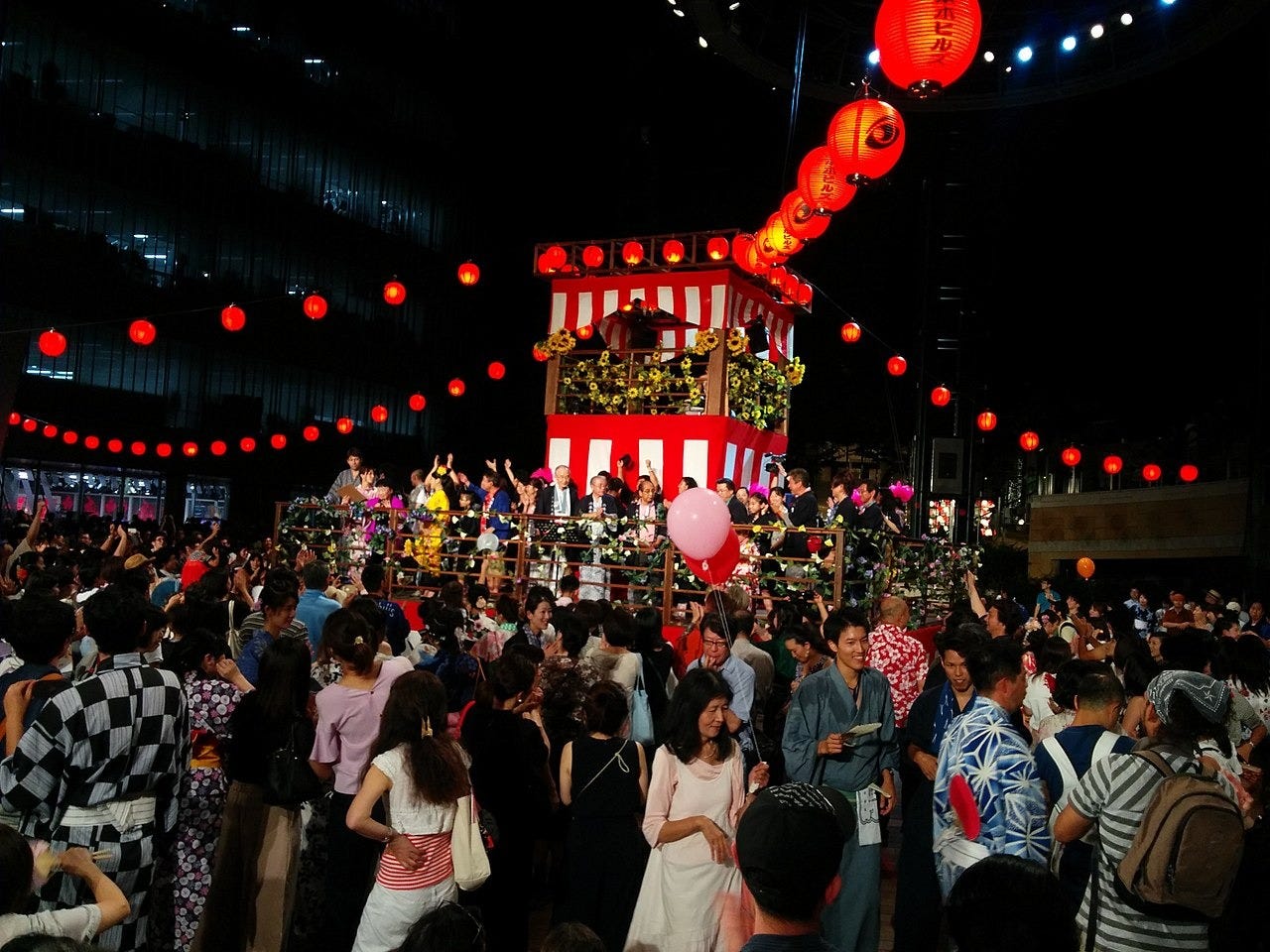
Obon used to be much more adult. If you didn’t know, Obon is a well-known festival still celebrated today to welcome the spirits of the dead who are visiting family members.
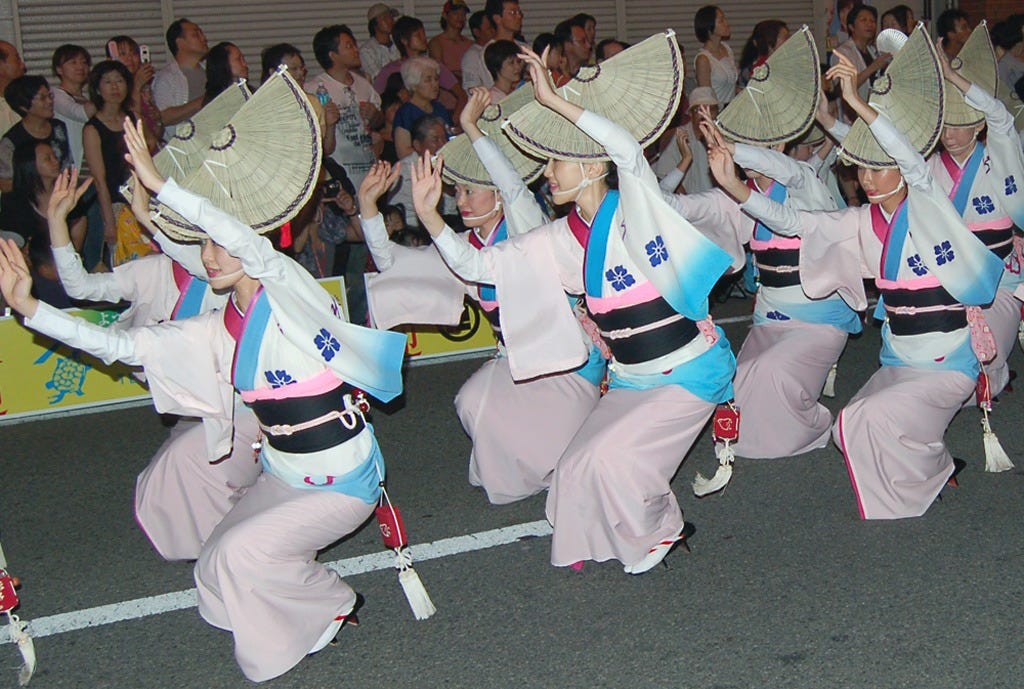
In the past, on Awaji, female villagers performed group dances during Obon. They wore folded straw hats that covered their faces.
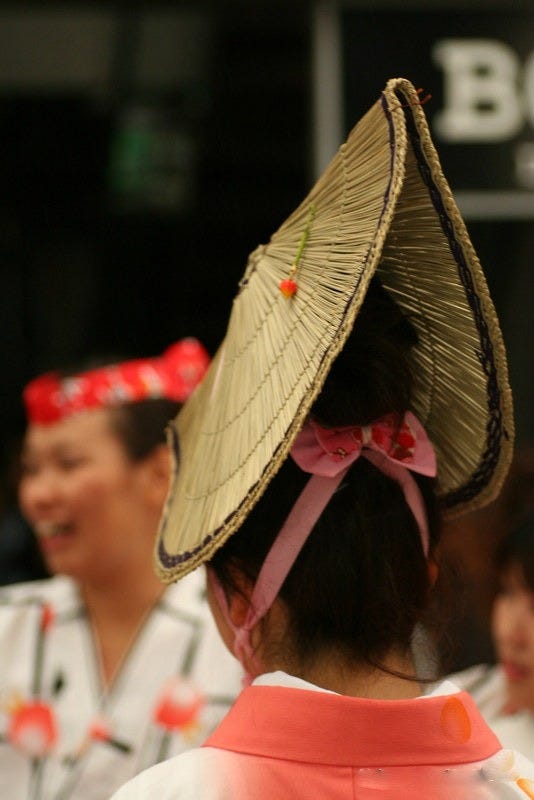

Afterwards, men in the audience came up to a girl they liked and asked to spend the night with her. Even married people did it. After that night, no one talked about what happened during Obon, even to their spouses.
One person in the Meiji period wrote about his childhood regarding Obon. In his hometown, people loved the Obon dance. Women danced in a circle while men in masks stood in the audience. When a man spotted a woman he liked, he entered the circle to signal his interest.
The author heard one masked man say, “You went to the Atago mountain last night, didn’t you?”
His friend replied, “No, I didn’t.”
“Oh, I know you did.”
A third man said slyly, “If you go there in the morning, you’ll find all sorts of things left on the ground.”
They laughed. The author, who was still a boy, felt a sneaking suspicion the adults were talking about something dirty, and ran home.
And that was how I grew to hate a little boy from the past. Imagine what interesting, juicy information we might have lost because a boy felt icky.

The Yami Matsuri, or Hell Festival, in Fuchū celebrated the god Jizo. It seems really fun. It started off with a parade across town where people carried around an altar with a phallus on it, a parade that left a hundred awkward conversations between parents and young children in its wake. The partygoers drank and sang and generally made a lot of noise.
After a while, someone would cut electricity to the town, covering it in darkness. The paraders then headed to a local shrine. It was said that Jizo (specifically rokujizo, a row of 6 Jizo statues) liked darkness and encouraged people to do crazy things.
People danced and sang at the top of their lungs and made noise until they reached the shrine, at which point they…sang and danced some more. The party eventually escalated to sex and lasted until dawn. The authorities tried to ban this festival multiple times, and finally succeeded in 1953.
These festivals have mostly vanished or they’ve been much toned down these days, like washed out rock bands playing acoustic versions of their old bangers. As Japan industrialized and became more connected, it unfortunately got harder to hide your typical mass orgy from the authorities. You’d be hard-pressed to find one today. Oh well, at least we still have OnlyFans creators.
References
Ryang, Sonia (2006). Love in Modern Japan.
https://en.wikipedia.org/wiki/%C5%8Ckunitama_Shrine#Kurayami_matsuri
The Yami festival in Fuchu... Is that the present day Fuchu City of Tokyo?
I live in Fuchu and sadly, even at the biggest festivals in Fuchu (there is a very large shrine - Onokunitama Shrine https://www.ookunitamajinja.or.jp/ right by the station and shockingly while the Japanese do get pretty drunk at the festivals no street orgy (which might be fortunate as not only does my wife sadly not have the old fashion view of it being ok that I rail random girls in the street (or even a love hotel) she also has a sharp katana hidden somewhere in the house).
One can clearly see where modernization has sucked out the soul of Japan
ee ja nai ka (1867). I wrote about it recently. 🙂