

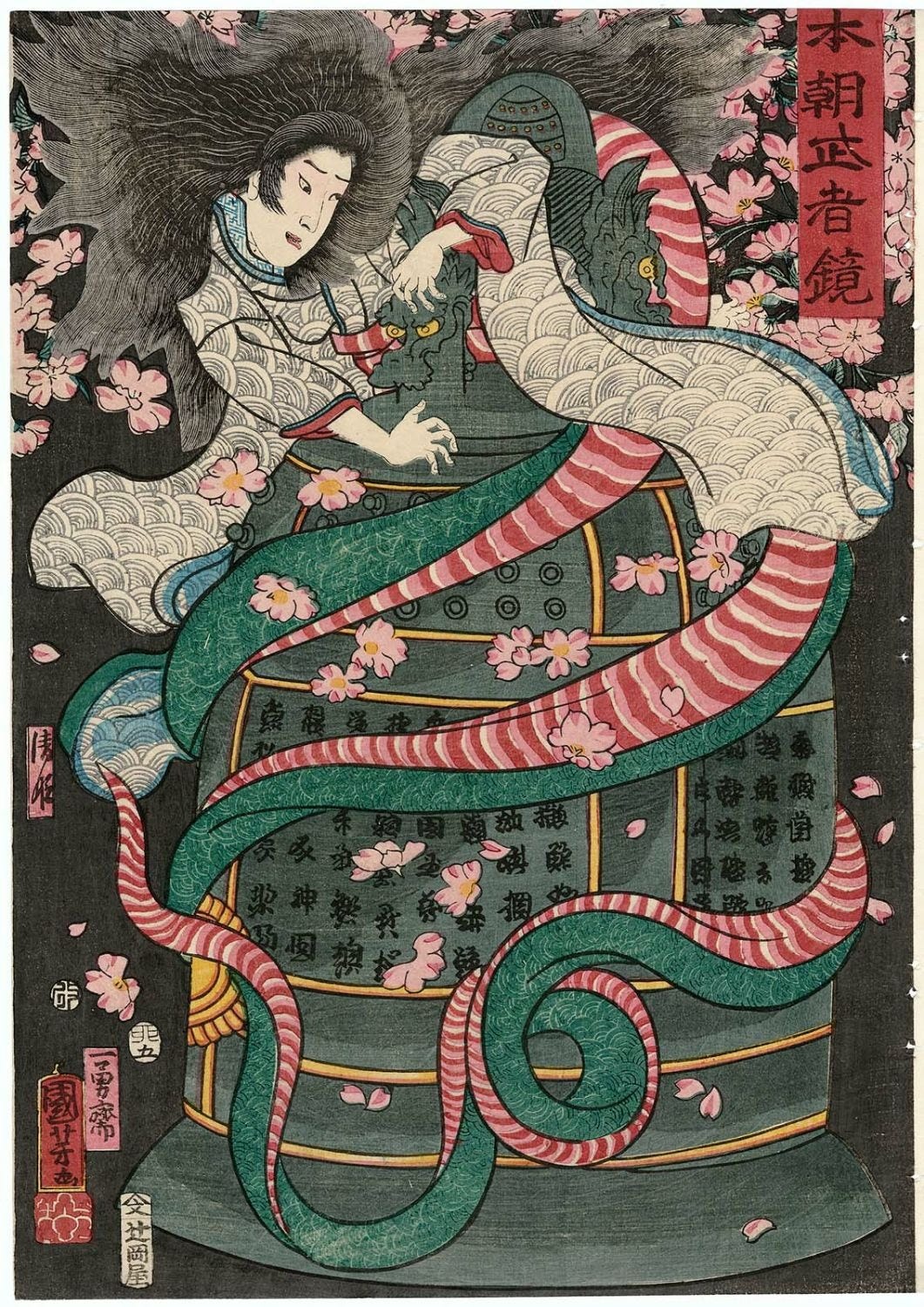
Today’s tale of burning interspecies love regularly pops up in Japanese art and literature. Its earliest known source is the Dainihonkoku Hokekyō Kenki 大日本国法華経験記 (Miraculous Tales of the Lotus Sutra from Japan), a collection of stories compiled between 1040 and 1043 by a Buddhist monk. The Lotus Sutra is one of the most important texts in Buddhism, and this collection was meant to convince people how awesome it is.
Two monks set out on a pilgrimage to Kumano 熊野, one young and handsome, and one old and not sure why he’s in this story.
They stopped at an inn kept by a young widow, who promptly fell in love with the handsome young monk. When she tried to sneak into his bed he told her he had taken a holy vow of celibacy, and he could not sleep with any lustful wenches, widowed or not. Until after his pilgrimage. But he promised to totally stop by on his way back from Kumano.
The handsome monk did not take a holy vow of not lying, so on their way back home the two monks took a different road and avoided the inn. When the spurned widow realized what had happened, the treachery killed her. But that wasn’t the end. Her tormented spirit transformed into an enormous serpent filled with rage.
The two monks found themselves pursued by the giant snake, so they took refuge in Dōjō-ji 道成寺, a Buddhist temple. In an effort to hide, the young monk stood underneath the large temple bell which was then lowered over him. Dying of asphyxiation in a claustrophobic space seemed preferable to sexy times with a large, angry snake. This monk don’t want no anaconda unless she’s a chaste nun, hun.
The anaconda in question was anything but pleased with the tintinnabulary arrangement, and coiled around the bell. In a feat that defied biology and physics, she bled from her eyes and spewed poison gas from her mouth to burn the bell.

Only ash remained of the handsome monk. The old monk returned home alone, sad at having lost his friend and at having contributed absolutely nothing to the plot.
Remember, this was all supposed to be Lotus Sutra propaganda. So one of the wiser monks at Dōjō-ji organized a mass reading of a chapter of the Lotus Sutra, whose miraculous power was enough to save the spirits of both the widow-snake and ash-monk and reincarnate them in less snakey and ashy circumstances.
Later versions of the story name the younger monk Anchin and the woman Kiyohime. The snake transformation is also more carefully and scientifically explained. Kiyohime pursues the monks in human form until she reaches a river. The monks had begged the ferryman to deny the crazy stalker lady passage. In anger and desperation, Anchin throws a hissy fit, changing into a giant snake to swim across.
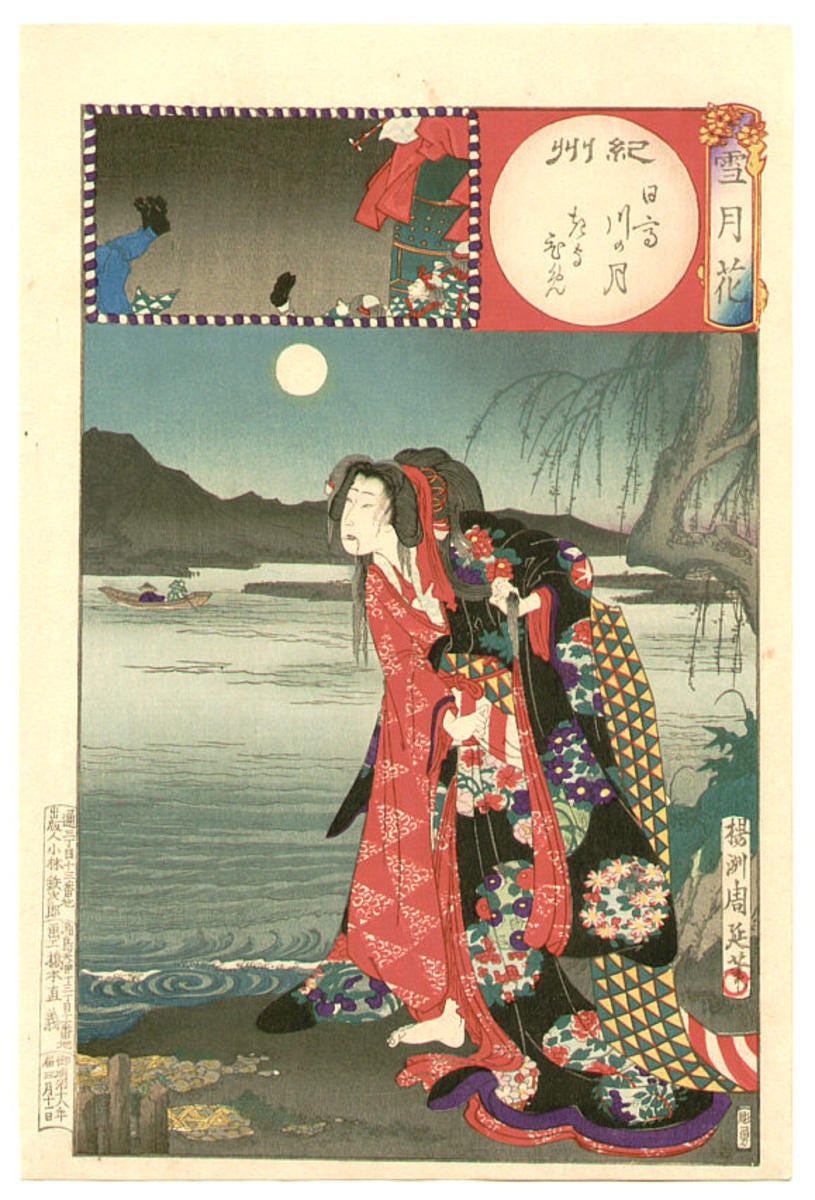
Kiyohime stranded by the river, ready to get her snake on.
The story is a staple of Nō (Dōjōji 道成寺), Kabuki (Kyōganoko Musume Dōjōji 京鹿子娘道成寺), and Bunraku puppet theatre (many versions), and the river crossing scene in particular is very well known.
References
Salz, Jonah (ed.) A History of Japanese Theatre. Cambridge, 2016, pp. 411–415.
Ury, Marian. Tales of Time Now Past: Sixty-Two Stories from a Medieval Japanese Collection. U of Michigan, 1979, Chapter 14.
Waters, Virginia Skord. “Sex, Lies, and the Illustrated Scroll: The Dōjōji Engi Emaki,” Monumenta Nipponica, Vol. 52, No. 1 (Spring, 1997), pp. 59–84. https://doi.org/10.2307/2385487
Dude, I actually had to look up "tintinnabulary". I always learn from your videos, especially about how the Fujiwara clan famously married their daughters into the Imperial Family, allowing them control over the Heian court for 200 years, but now I'm improving my vocabulary too. Amazing work.
Spread the knowledge 🧠🔔