

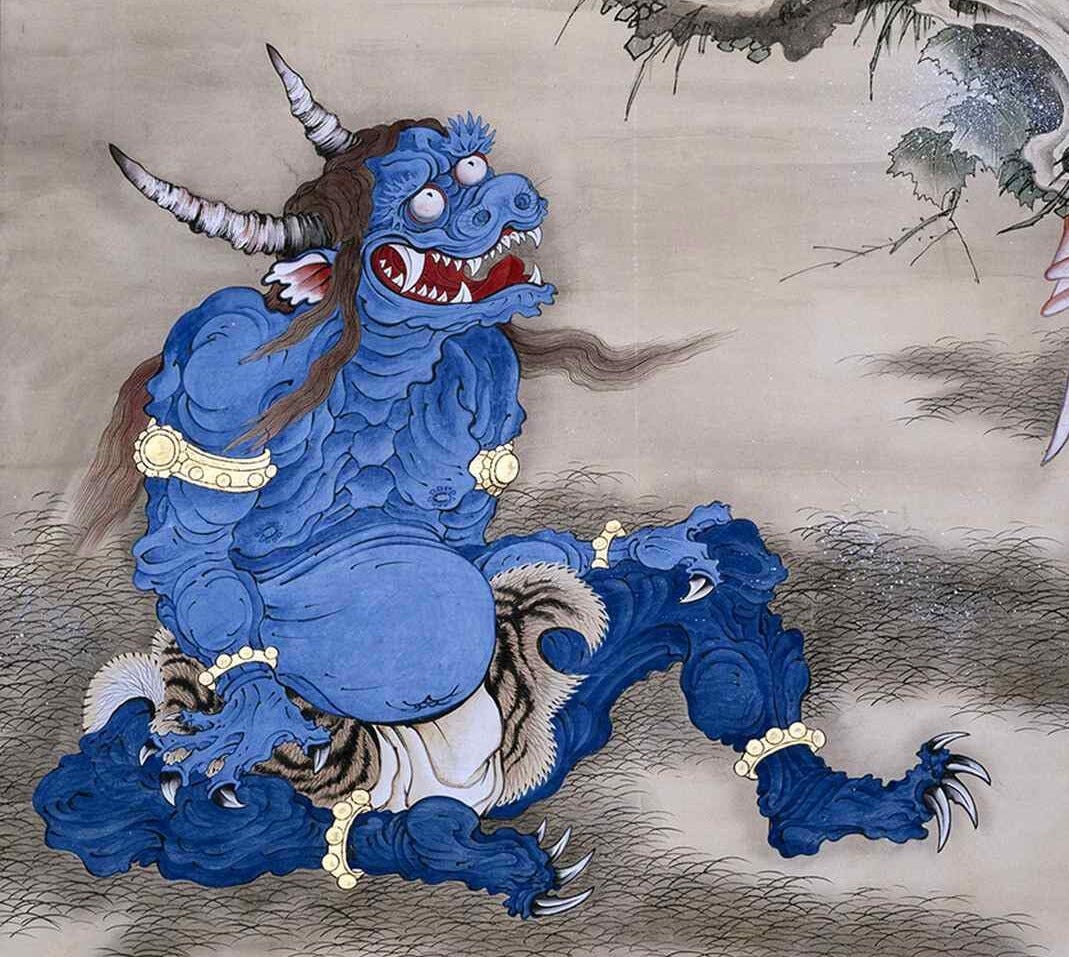

I’m sure many here are fairly familiar with “oni.” You know, those big, lumbering, ogre-like creatures with horns, sharpened teeth, typically colored red or blue and often carrying around the big kanabo metal clubs. But what if I told you that the o.g. oni from nigh 1000 years ago were actually quite different from their big, burly counterparts.
There’s a collection of folktales from the Heian Period, the Konjaku Monogatari Shu, with a good number of stories about “oni,” and you might be surprised to find that they were only ever vaguely understood and, as a result, ending up being quite a diverse class of monsters.
Most of them were only briefly glimpsed in the dark if seen at all (there’s even one story where the oni is completely invisible). Quite often the only evidence of an oni’s existence is the absolute human mess they leave after they devour someone, as in the case of the story of Ariwara no Nariha losing his lover to an oni in an abandoned shed, or the government official who is killed in the Daijokan in the palace, or most disturbingly, the woman who is snatched away and found folded over a clothes pole with all of her blood and insides seemingly sucked out of her.
Then there are the shapeshifting oni such as the the one who turns into a very handsome man that disappears with an unsuspecting young woman in an open space in the imperial palace complex, or the oni that takes on the form of an old lady in an abandoned house in the mountains of Kitayamashina.
There are also the oni who turn into inanimate objects such as the flying plank of wood that kills a sleeping, unarmed man or the oni that turns into a small, ceramic vase and brings a death curse to an unnamed house. But perhaps my favorite oni story is the one that haunted Agi Bridge. In that story, the oni first takes on the appearance of a beautiful lady to lure in her prey but transforms into a 9 foot tall monster with a red face, blueish-gray skin, dagger like claws and a single amber eye in the middle of its head; the only good description we get for what an oni’s true form is. No mention of horns, funnily enough.
While most oni are only concerned with devouring a whole smorgasbord of human beings, not all of them have the same motivations. There’s the oni of an unnamed, abandoned temple in the capital that takes on the form of a woman and simply wants the lovers who intruded on her turf to just leave. Unfortunately for the lady intruder, she doesn’t vacate the premises fast enough and is rendered comatose by some kind of curse only to die shortly after, but never actually eaten.
There’s an instance of an oni at Kawara no In that just wants to steal the contents of a bag full of snacks, and then there’s the aforementioned invisible oni in the imperial palace that seemed to only want to pull a practical joke on the emperor by repeatedly moving a standing lamp from its designated place into the adjacent building and leaving it middle of the floor. It eventually runs away after getting kicked by a brave courtier and hiding in a closet for a night.
So while we can all appreciate the modern depictions of oni as hulking, horned beasts or as is increasingly becoming common, as cute anime girls, just remember that the oldest descriptions of oni were far more vague and, subsequently, diverse. Do with that information what you will just don’t get too carried away, ok?
This is a guest post from Tales of Dawn and Dusk! Check out his video on the ancient Japanese horror story of the Demon of Agi Bridge here:
The Heian period was crazy. Did you know that the Fujiwara clan famously married their daughters into the Imperial Family, allowing them control over the Heian court for 200 years?