

🚨 Some images are explicit, be warned.
This lovely woodblock print has a sequel that your mother will disapprove of.
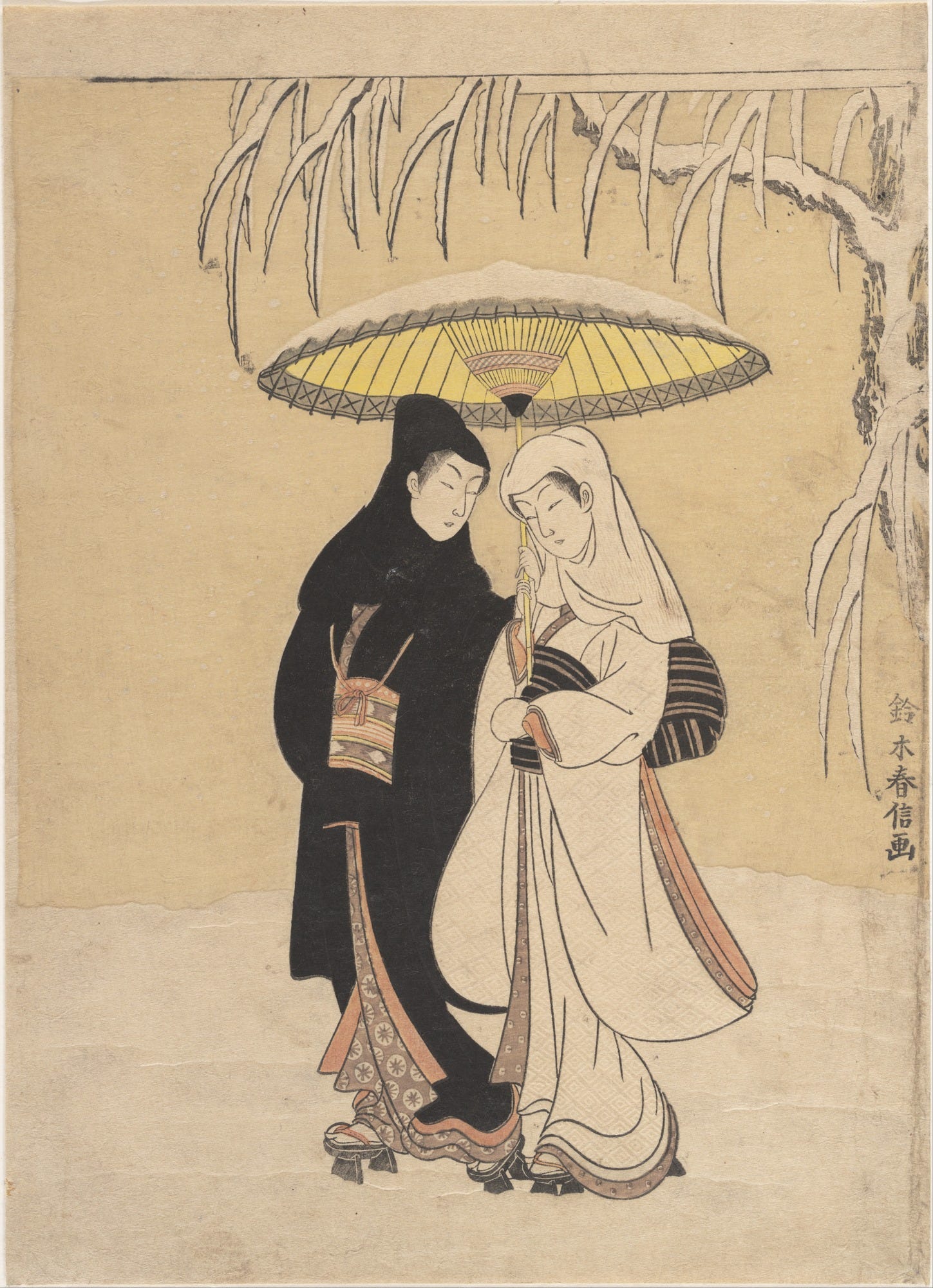
Made by Suzuki Harunobu 鈴木春信, it shows a couple under a willow tree in a snowy landscape. The artwork is called Shared Umbrella or Crow and Heron in the Snow, because of their black and white clothing.
They’re dressed like the kind of people who sip wine from fancy lacquerware cups while showing concern for the lower class. He wears a sleek black coat while she has a pure white kimono. Rich patterns adorn their clothes. Her unplucked eyebrows and long sleeves tell us she’s a young unmarried woman.
It doesn’t look like it, but they’re doing something inappropriate for a couple in the Edo period (1603 - 1868). They’re strolling side by side, holding an umbrella. In public, ideally, the woman was supposed to walk behind the man, close enough to be related, but far enough to leave room for the patriarchy. Sharing an umbrella intimately like this would have been a public display of affection that got you looks (some envious no doubt).
The couple may be heading towards a double love suicide. Their black and white colors mirror the traditional colors of a bride and groom, turning the image into a kind of doomed wedding portrait.
The wedding colors make their devotion clear, and that devotion becomes a tragedy. A double love suicide usually happened when society condemned the couple’s relationship. Their only escape was to leave the world together.
A followup print was later made, either by Harunobu or another artist named Isoda Koryūsai. We’re not sure who because it was unsigned. It was called Lovers Under a Willow in the Snow.
Unfortunately, I cannot find an image of the colored print online so you’re stuck with this black-and-white photo I took from a book (if any ukiyo-e experts can find a color image, you’d be my hero and I’d write you a haiku).
Update: User lyca found a color image here, my actual hero. As promised, the haiku is at the end of the article.

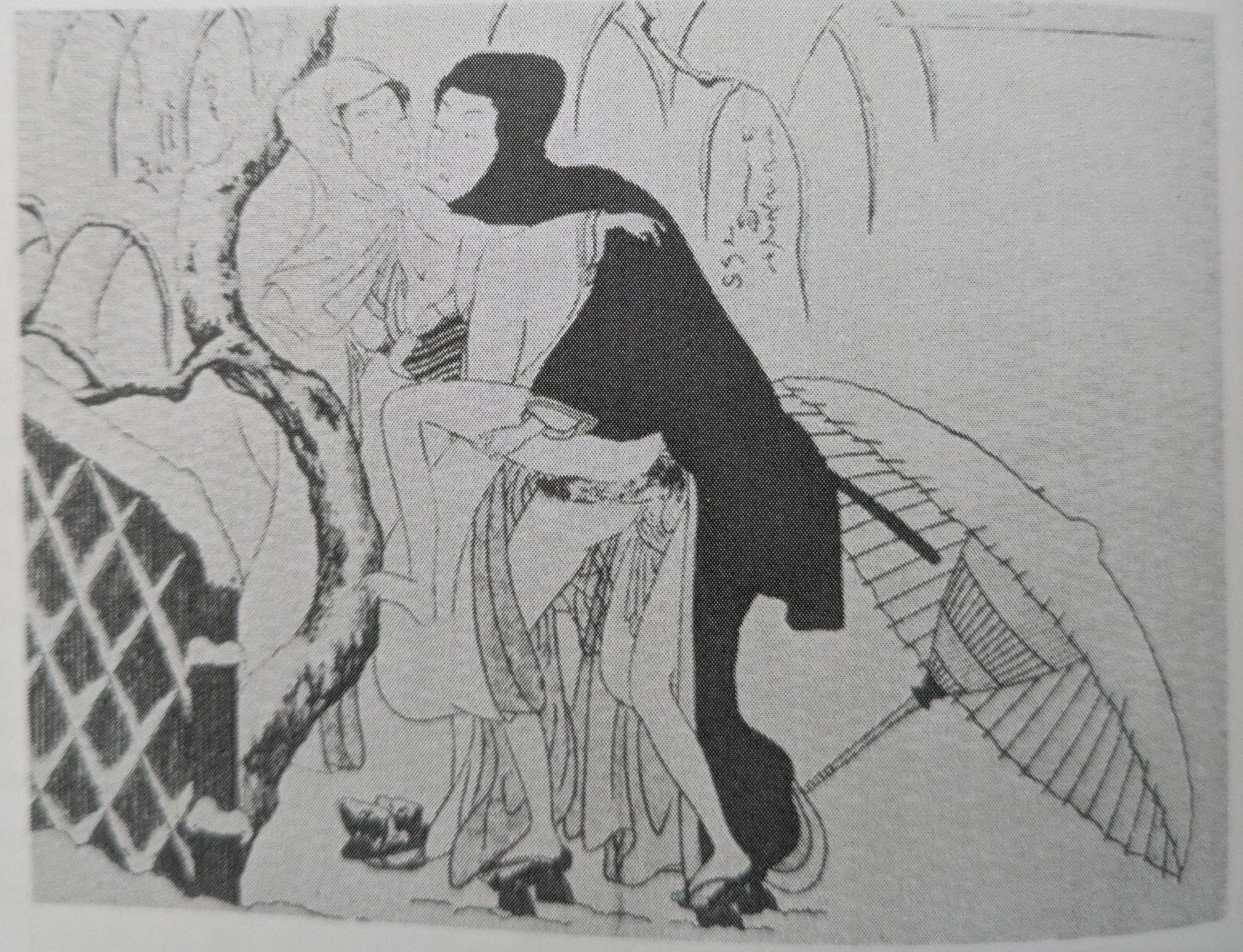
The follow-up print shows the same couple, no longer so elegant. She leans on that same willow, pulling up her robe for the man about to commit several violations of the Confucian codes of decency. The umbrella lies forgotten. Their dialogue text reveals something funny: they don’t speak in a high-born manner at all.
“Is it all right if I lean on the bend in this tree to do the thing I want?”
“No need to ask.”
It might look like a parody of the first print, but nope. It’s actually part of a common practice where artists riffed on each other’s art. One artist may take an old piece he did or he’d take the work of a different artist and make another version, changing certain parts or continuing the story.
In today’s terms, it’d be like:
John draws Mario jumping on a Goomba
Hannah draws both Mario and Princess Peach jumping on a Goomba
Tom draws Princess Peach leaning on a Goomba with Mario plowing her from behind, while John and Hannah stare in horror. Tom is a maniac.
It may seem like the second print is making fun of the first, but it actually “completes” the story. These were both images meant to titillate. The average viewer of the first image would have been thinking something similar to the second image anyway. Why not give viewers what they want?
For user lyca who found the color image:
Snow hides its secrets,
but your eyes pierced winter’s veil.
The lovers are found.
Hey Linfamy, is this the image you were looking for a colour of?
https://assets.catawiki.com/image/cw_normal/plain/assets/catawiki/assets/2024/5/3/5/f/c/5fc0ae2b-db2a-4291-8e4d-1ed046e0cc56.jpg
it may be from the book Happy Togetherness for Umegawa and Chûbei (Umegawa Chûbei no kihan), from the series Eight Pledges at Lovers' Meetings (Ômi hakkei)
but i am not certain in any measure
Found this but it would seem a little late, and even a bit censored.
https://share.google/images/RgvNoDfHp2FyZ4wlm