

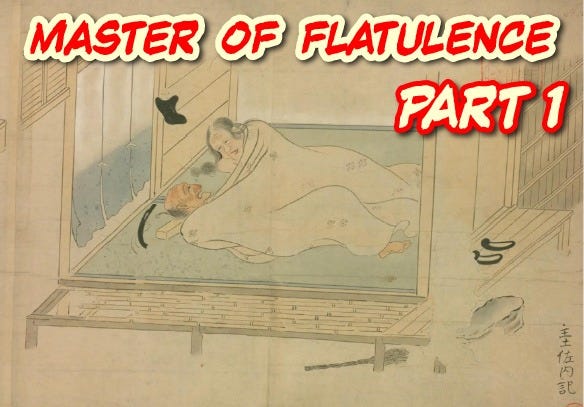
Japanese literature is full of beautiful, poetic works of high art full of meaning and symbolism, and then you have today’s story about a man who gains mastery over the art of passing wind, a work of literature that puts the rest to shame.
Some time in the Muromachi period (1336 - 1573), someone sat down and thought, “You know what Japan truly needs? A fart epic,” then drew a picture scroll called Fukutomi zōshi 福富草紙, or the Tale of Fukutomi. The name of this literary genius has been lost to time, possibly because historians kept laugh-fainting halfway through their research, but luckily we still have copies of his masterpiece.
Many versions of this scroll exist, the oldest copy we have today was made in the mid-1400s, though sadly we don’t have the original.
I present to you the first half of the story here. The second half, you’ll have to wait for the next post, because suspense works best when you feel a little pressure building. I’ll describe both the art and text. The details and dialogue really pull you into the story.
So sit back, relax, and empty your bowels for a fantastical tale of greed and people trying to rise above their station in life, a story that blows away the others.
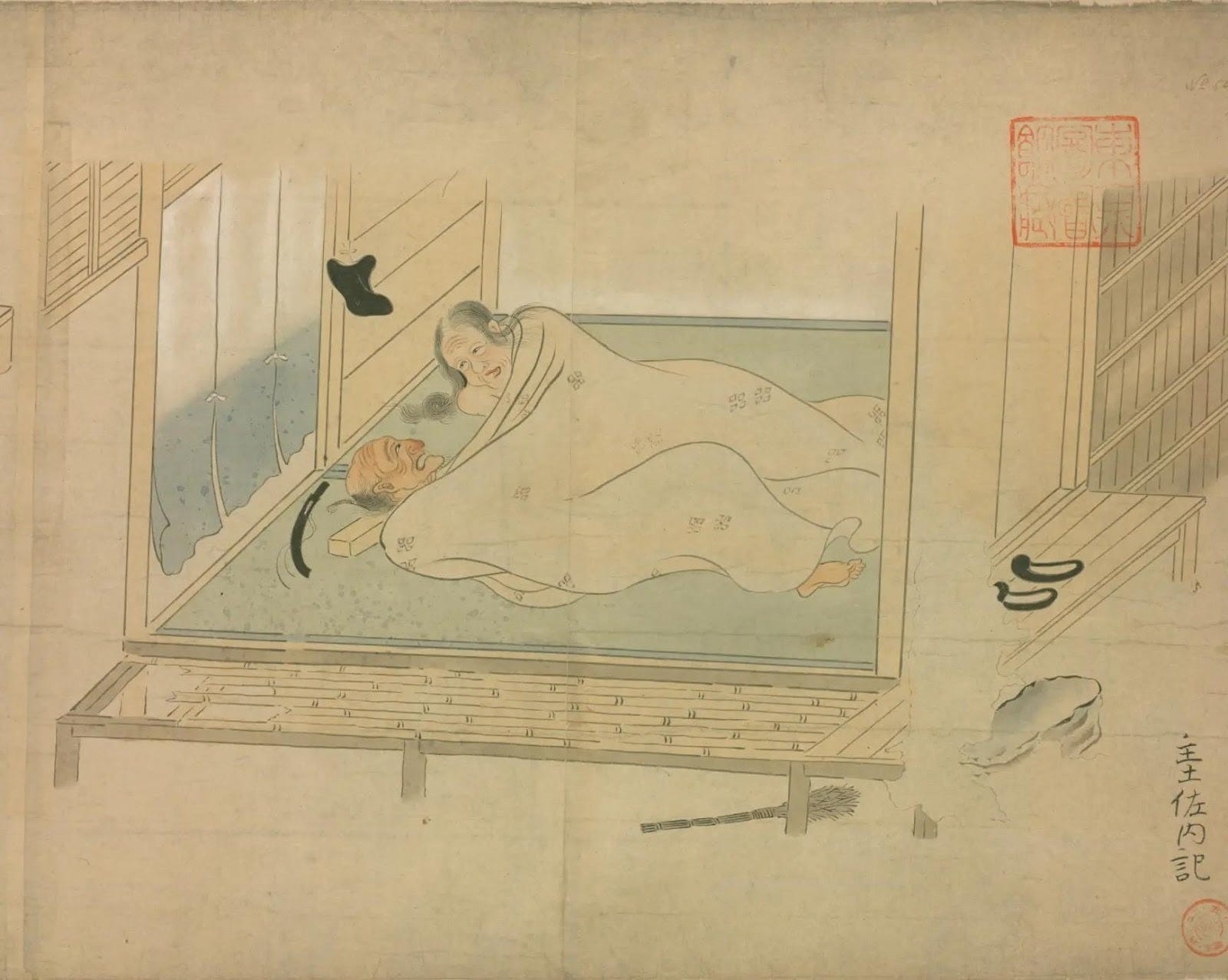
In Kyōto, there lives an old man named Takamuko no Hidetake and his wife. You can see from the sad condition of their house that their relationship to money is similar to the relationship between those who invest in crypto and success.
Their room is pretty much bare. The two curl together, the cold obviously biting them through thin sheets. They’re getting up there in age and unless something changes, their twilight years will be as dark as their unlit house.
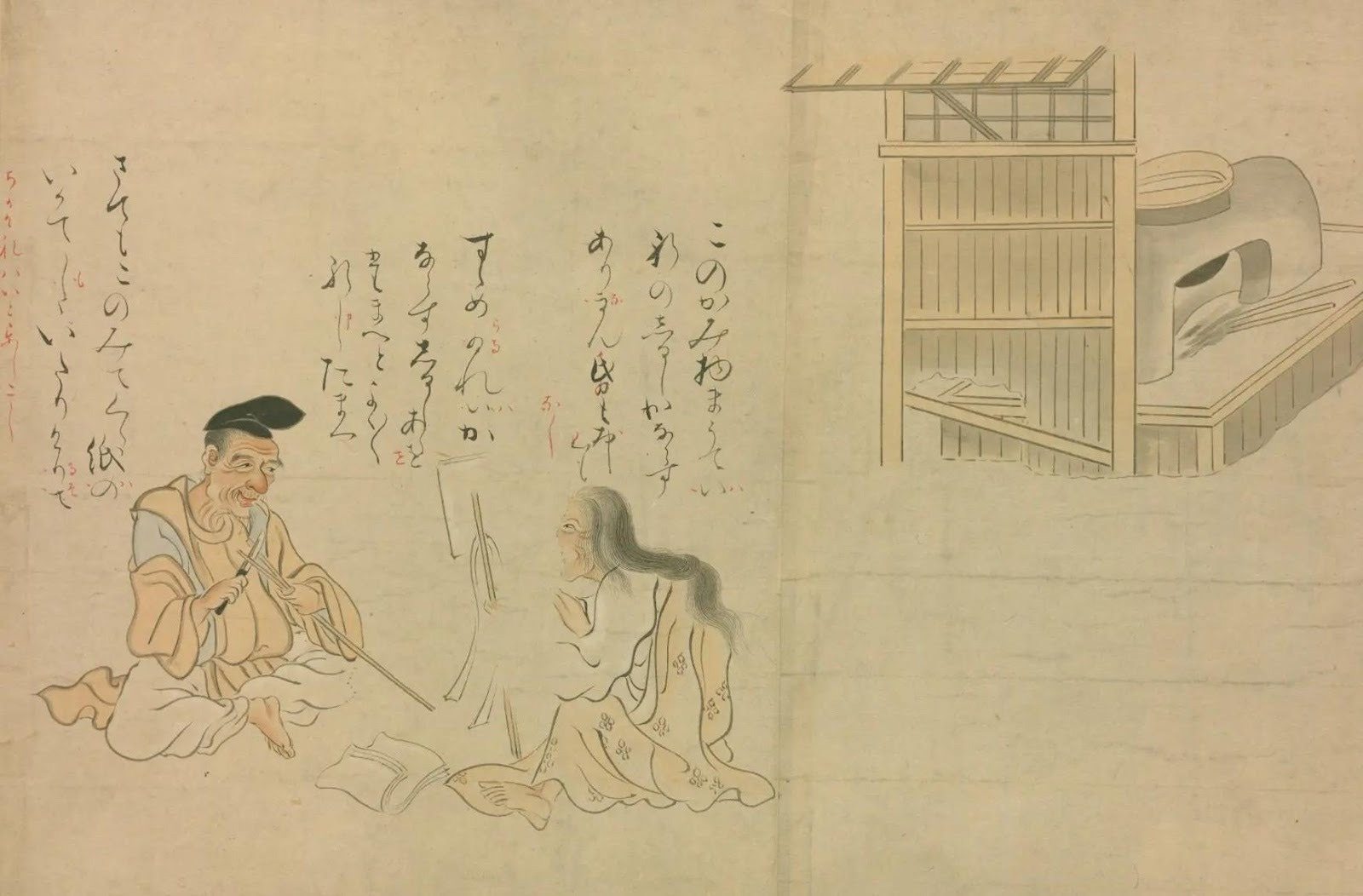
Deciding they must do something before it’s too late, the couple makes a gohei.
Hidetake asks, “What should I do with this thing?”
His wife responds, “You need this for a proper visit to the shrine. It is a symbol of prayer. No matter what it costs…if you keep praying, there will surely be a sign from the gods.”
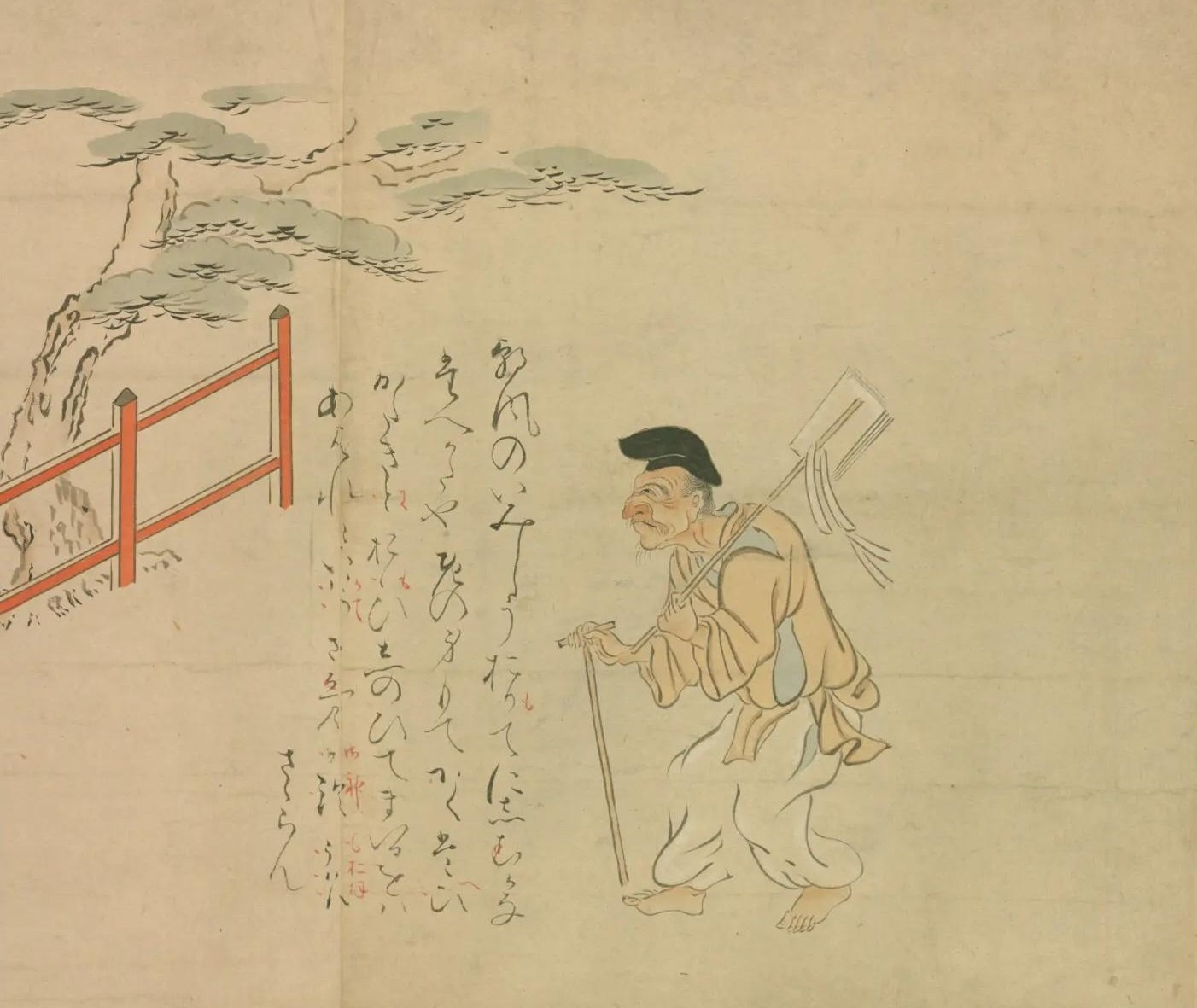
Hidetake walks barefoot to the shrine of the god of talent. Now Hidetake’s not some spring chicken, he’s more of a leftover drumstick. His creaking body can barely survive the journey, but he hopes that the gods will acknowledge his effort.
The words say, “The shrine is close now, that’s a relief. The morning wind stings my face and this old body can hardly endure any more. But in spite of all this, if the god of talent sees my miserable state and recognizes my determination, he will have mercy.”
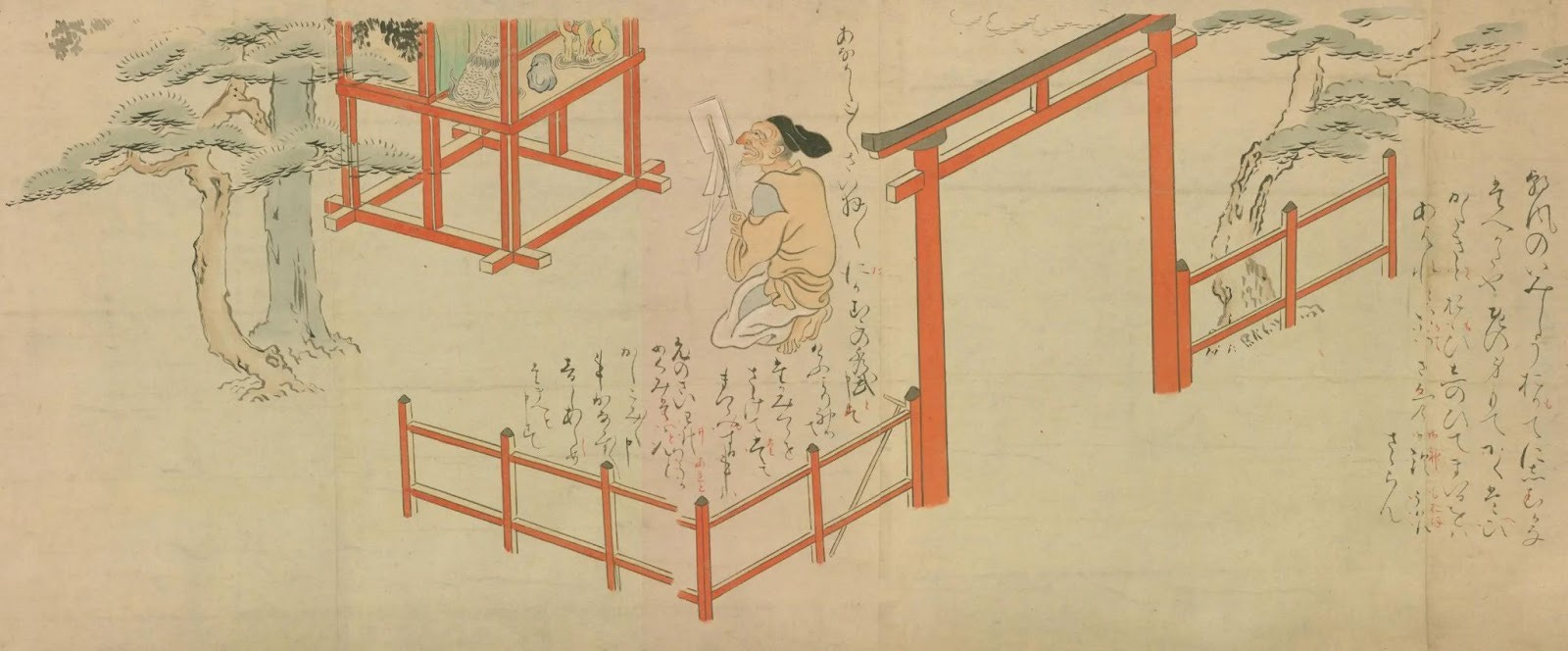
Kneeling before the shrine, Hidetake prays, “I am Takamuko no Hidetake. I pray to you today and make this offering in hopes that in some small way you could grant some bit of grace and relieve the suffering of this old man. I beseech you over and over. Please grant me a sign.”
The man’s serious. He visits the shrine every morning for seven days. On the seventh morning, Hidetake has a strange dream, and goes to a fortune teller to ask what it means.
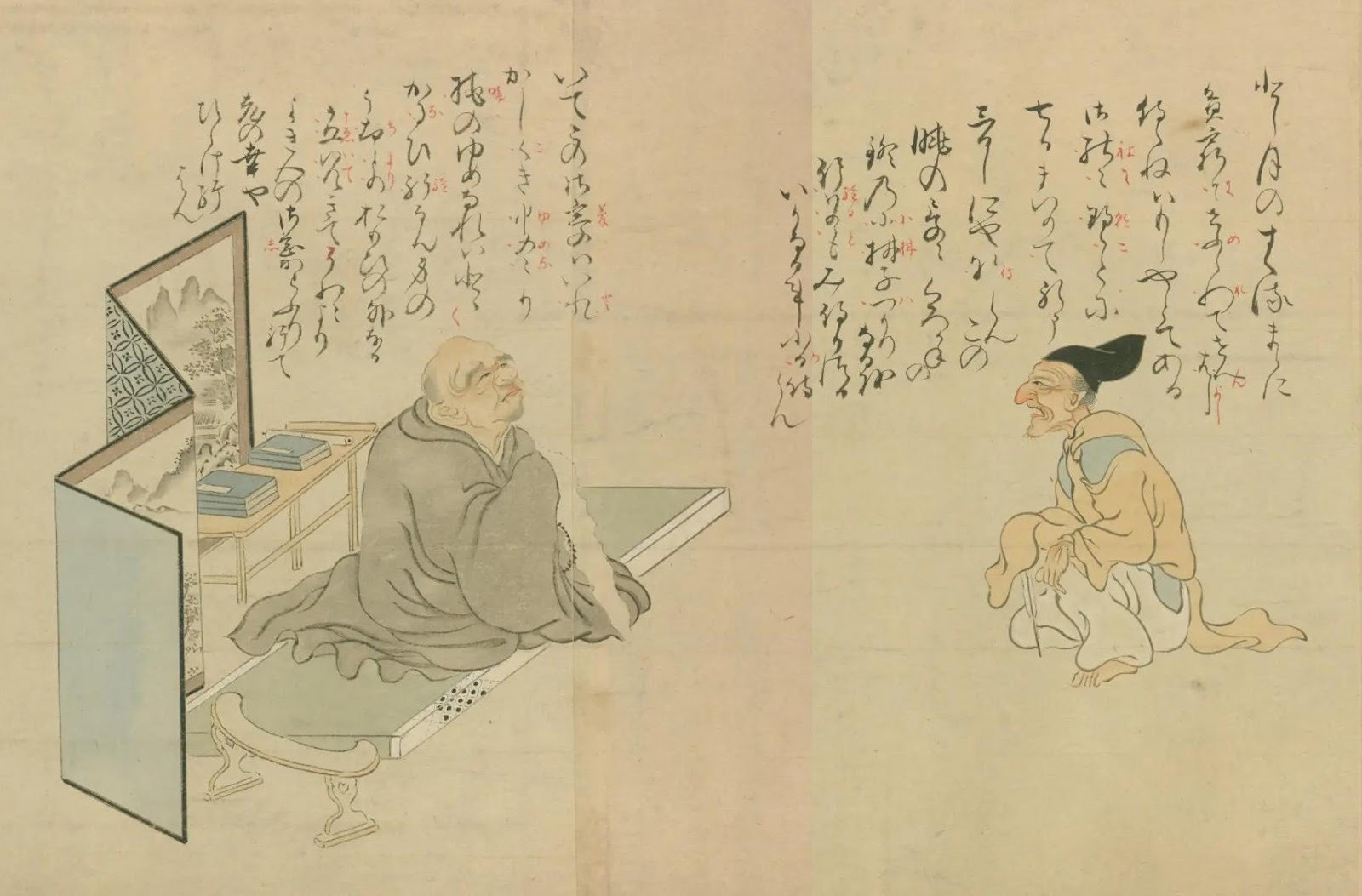
Hidetake says, “During months and years of oppressive poverty I had no hope or expectation that my luck would change. But entertaining the slightest possibility that change would come, I made a pilgrimage to the shrine on seven successive mornings and prayed that some sign would be given me.”
Then he reveals the dream. “At dawn of the seventh morning, I had a dream that I received a small iron bell, the size of a mandarin orange. And I pondered over the meaning of this.”
The fortune teller tells Hidetake something that fills him with hope, and more. “Surely you should be very thankful and humbled by this dream. A dream that occurs just before dawn will soon come to pass.”
Then his words become strangely specific, and, as we’ll see in a few moments, awfully accurate. “From inside your body, something unexpected will emerge. A voice will speak or come out. You will receive generosity from a nobleman and you, old man, will be given a new life.”
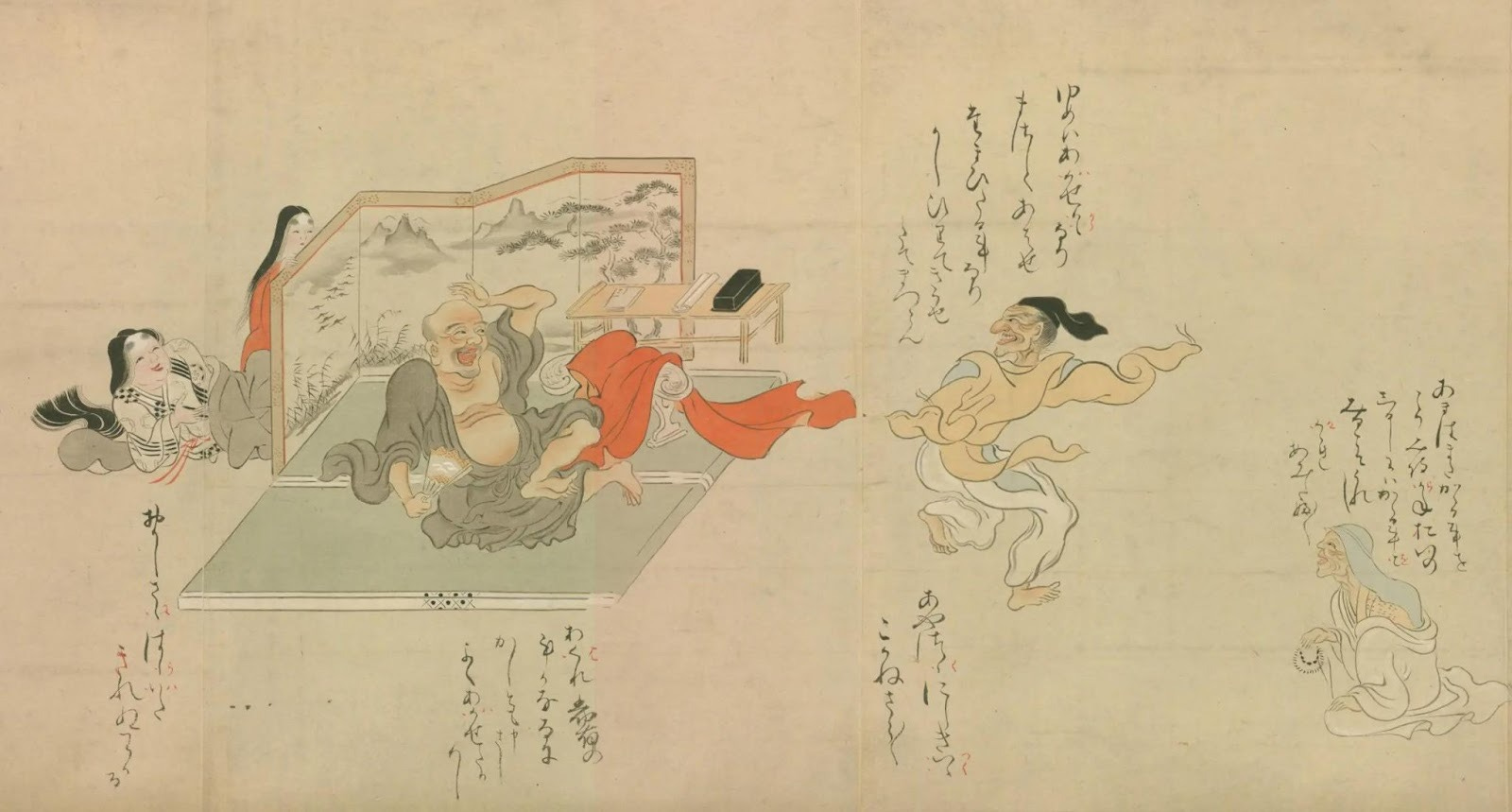
The fortune teller asks the old man to show off the gift he has just been given, the voice that rings.
Hidetake suddenly feels an urge deep within, something yearning to be free. He was no prison guard, who was he to keep a thing locked up? From his rump comes a sound deep and full, and it doesn’t stop until a whole song passes through his sonorous sphincter. Everyone in the room laughs, having a grand ol’ time.
The fortune teller wheezes, “What a rare thing we are witnessing! I’ve figured this dream out precisely and, if I do say so, am quite impressed with myself. What a funny thing! My gut is twisted from laughter.”
An old nun on the lower right says, “I’ve never seen such a thing. What a pleasure it is to witness this in my old age. I’m so thankful. Amida butsu, amida butsu.” Amida butsu is the name of the main Buddha in Pure Land Buddhism.
A young woman behind the screen is speechless, but not so speechless as to be unable to generate speech. “I am speechless,” she says. “I can’t find words to describe this sight.”
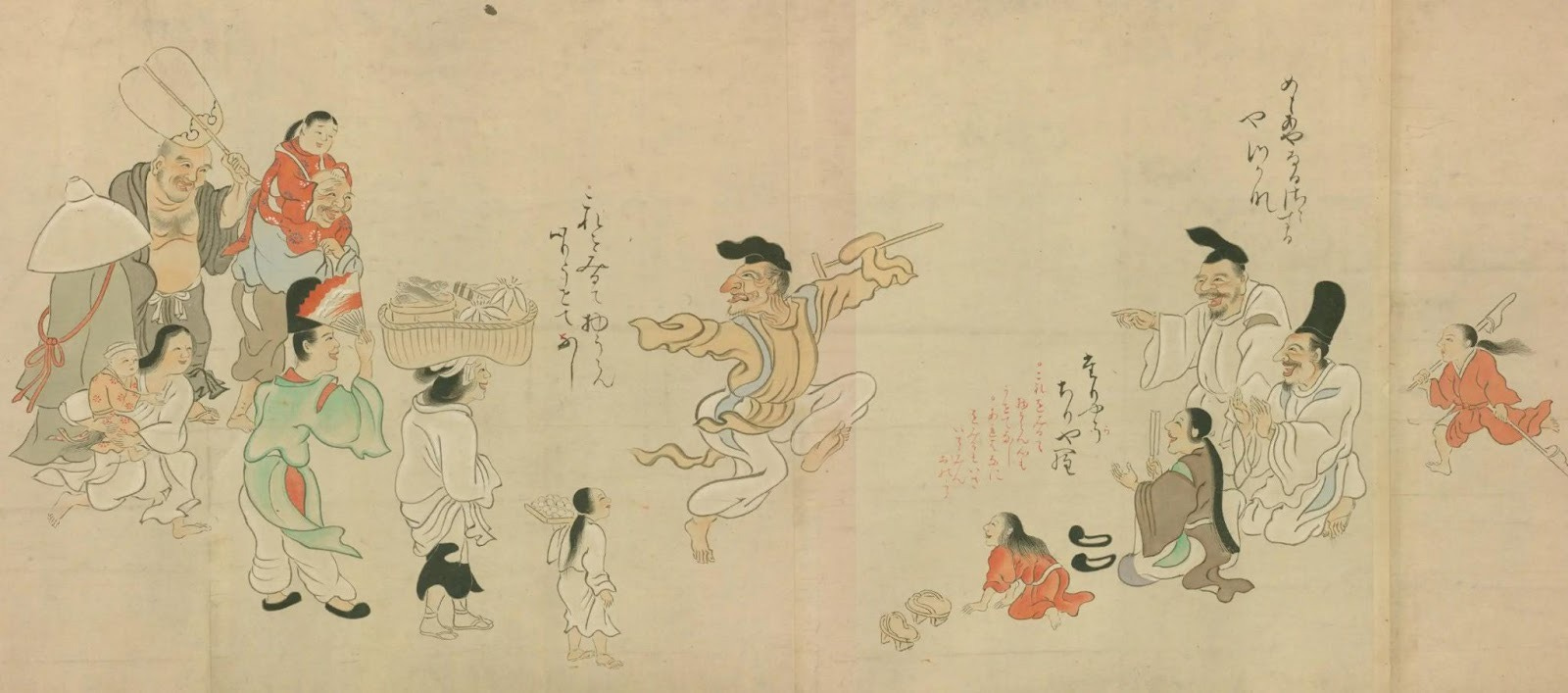
Overjoyed, Hidetake takes his gift to the streets, farting whole concerts. The crowd just keeps getting bigger. News of his performance spread faster than his odor.
“Take a look at this fellow! What an amazing talent!”
“This fellow is so funny that the thought of selling my wares has completely escaped my mind.”
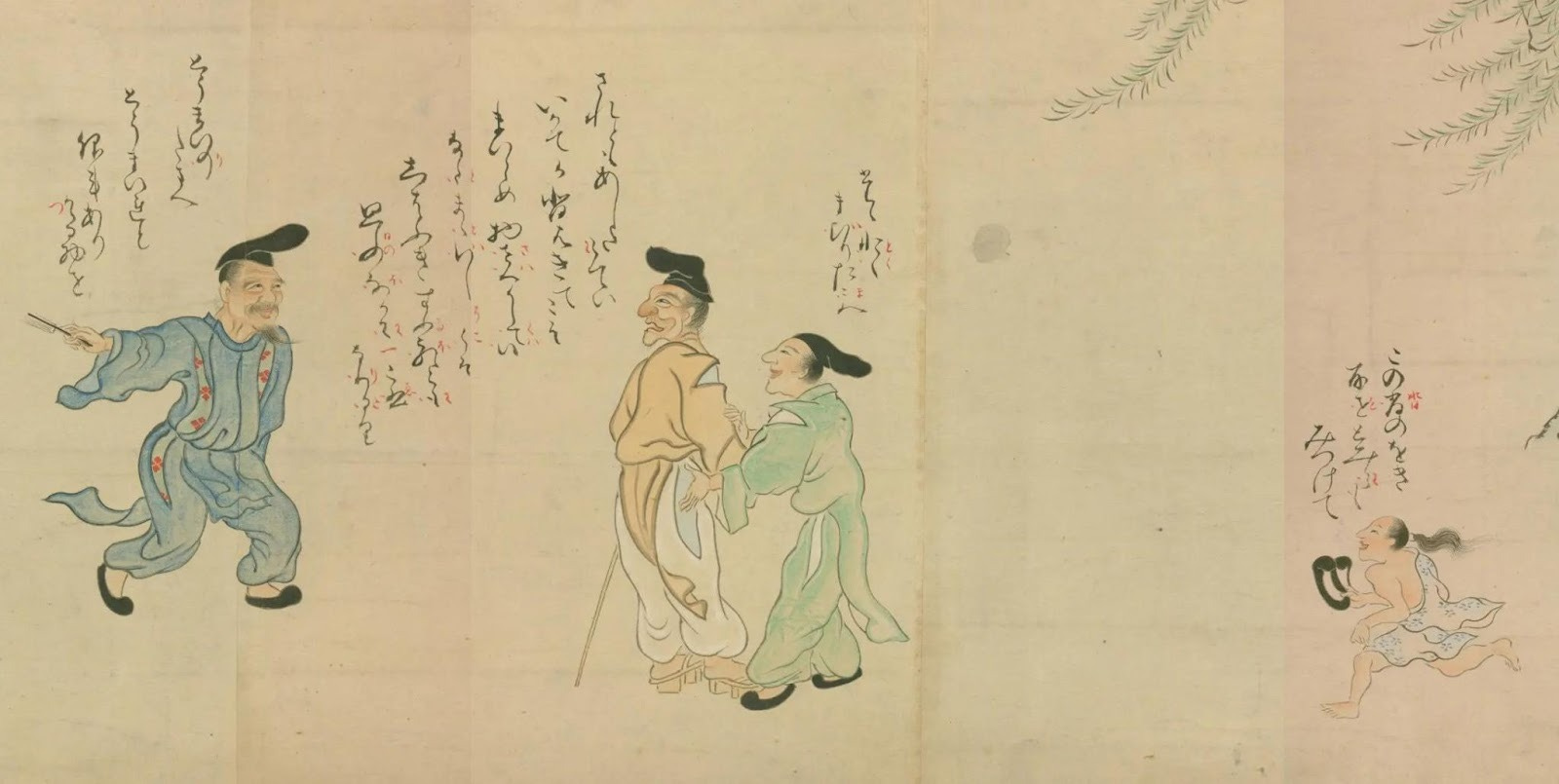
As he’s performing, a messenger comes over and invites Hidetake to his master’s residence. “Come quickly, come quickly! I was instructed by the master to bring you back as quickly as possible!”
Hidetake replies, “I would go soon if I had the proper footwear. Things are a bit disorganized at the moment. When I think I am about to emit a little cough, a much greater sound emerges from me.”
Luckily, a child on the right comes to the rescue. “Here, I’ve found where the shoes were placed!”
And so the soon-to-be platinum selling fartist agrees to visit the nobleman, and as he’s walking over he realizes that, oh my gods, it’s the grand residence of some wealthy nobleman. The winds of fate clearly have his back.
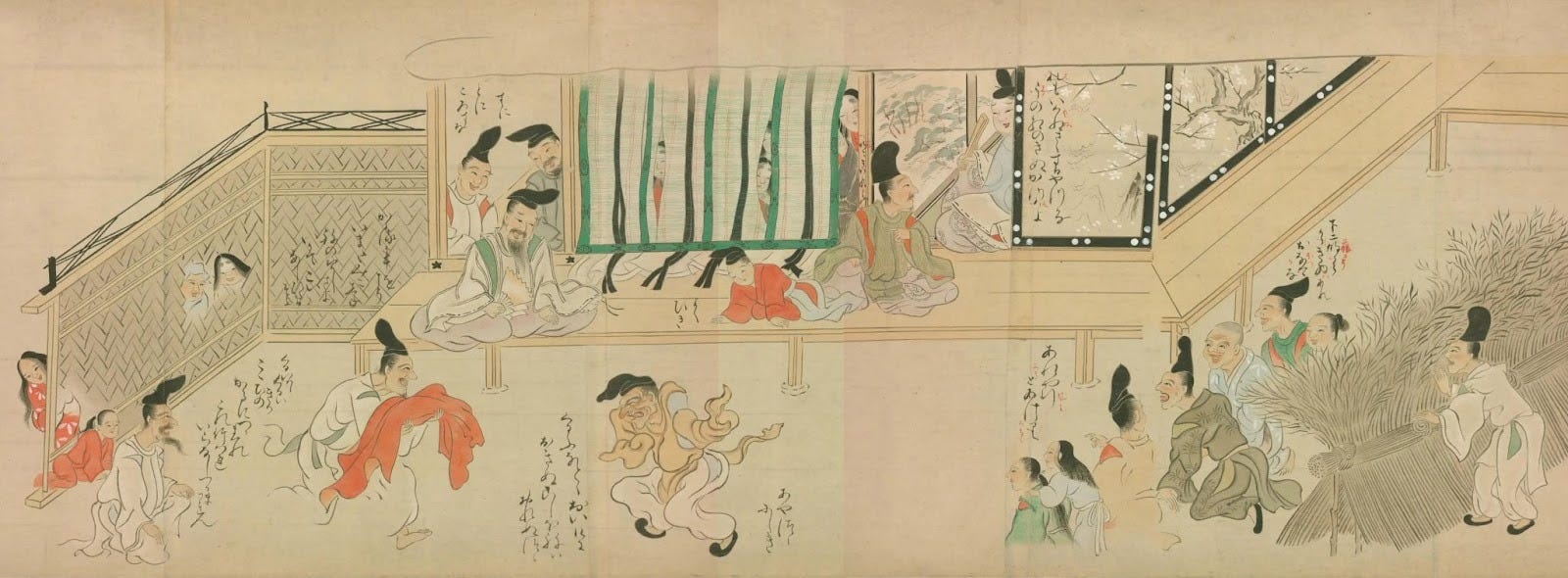
Hidetake makes the performance of his life in front of all the nobles, his clothes flapping from the wind of his astounding anus. The audience couldn’t take their eyes off, so enraptured they didn’t even mind the smell.
People watch from the sides, attendants from the veranda. One person gasps, “What a low life! What a character! Is that smell coming from the cooking pot?” Another remarks, “Look! His garments are flapping as if blown by the wind.” A boy says, “He farts so well!”
Women peer from their drapes. “Tell him to visit regularly,” says one.
Some men on the left seated inside the house say, “He is so old he could be killed by this wind. Save some for next time. Don’t let him kill himself in his enthusiasm.”
Further left, commoners sneak looks from holes in the fence, saying, “I have never seen such a fellow before! Those sounds are strange and rare. How did he acquire this skill?”
The nobleman watches from behind a screen. “What an amazing fellow, this chirping man. Bring him the scarlet robe.” An attendant comes bearing a red robe for Hidetake. To the left of him, a man says, “Whirling and spinning madly! How skillfully he plays the melody! Give it to him!”
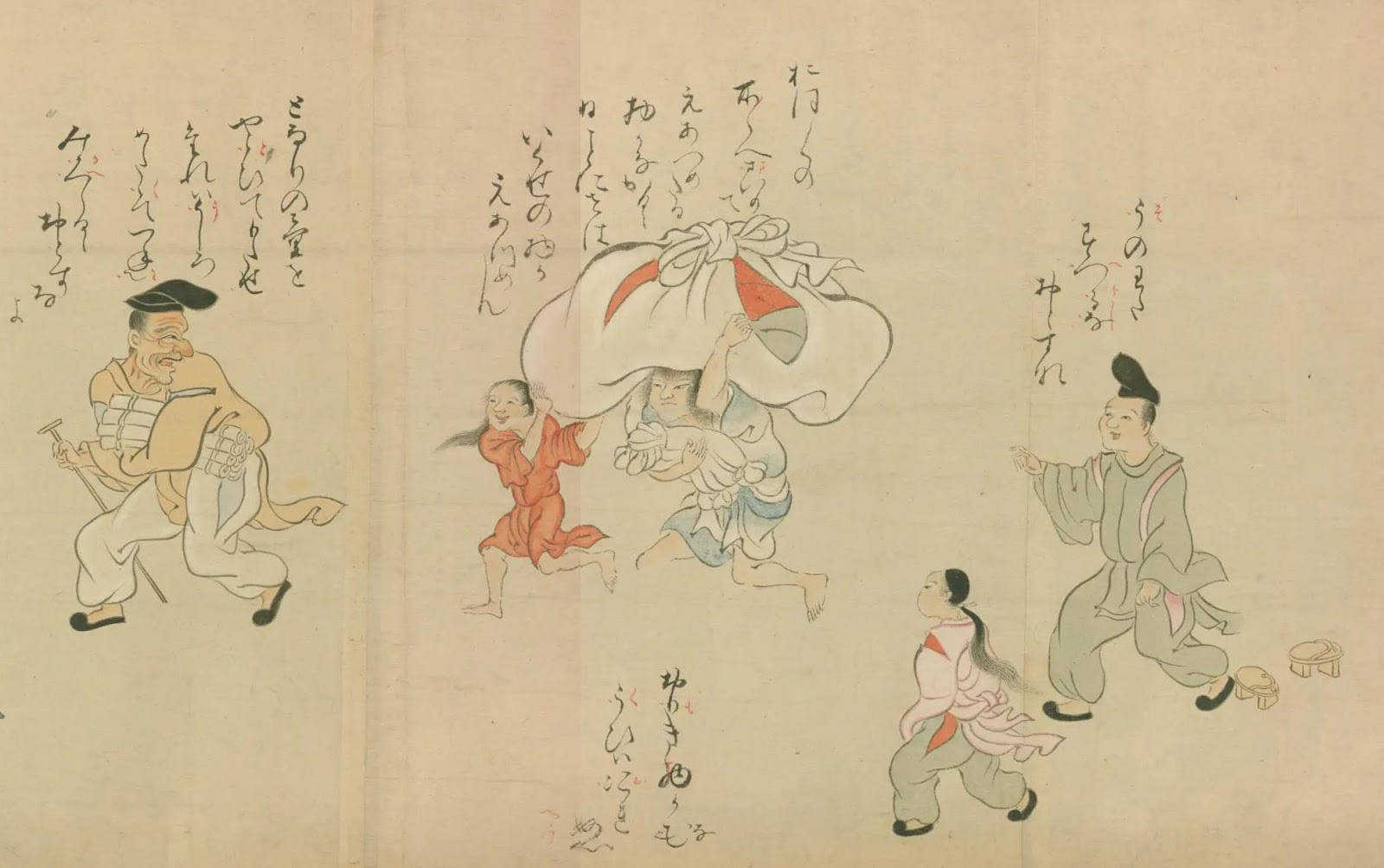
The nobles shower him with gifts, which he hires people to carry home.
A young man on the right says, “Careful! Don’t let the wata slide out!” Wata is a bit of a cheeky pun. It can mean cotton fabric, or it can mean guts or bowels. Either way, we can all agree it is best to keep it inside.
His bag carriers say, “What a load he has collected from various places! If he does this everyday, think of how much more he will be able to amass.” And below that, “This thing is so heavy I think my neck is going to break!”
Hidetake’s looking back, thinking, “I’ve hired a neighbor to carry those things. Hey! Don’t drop it!”
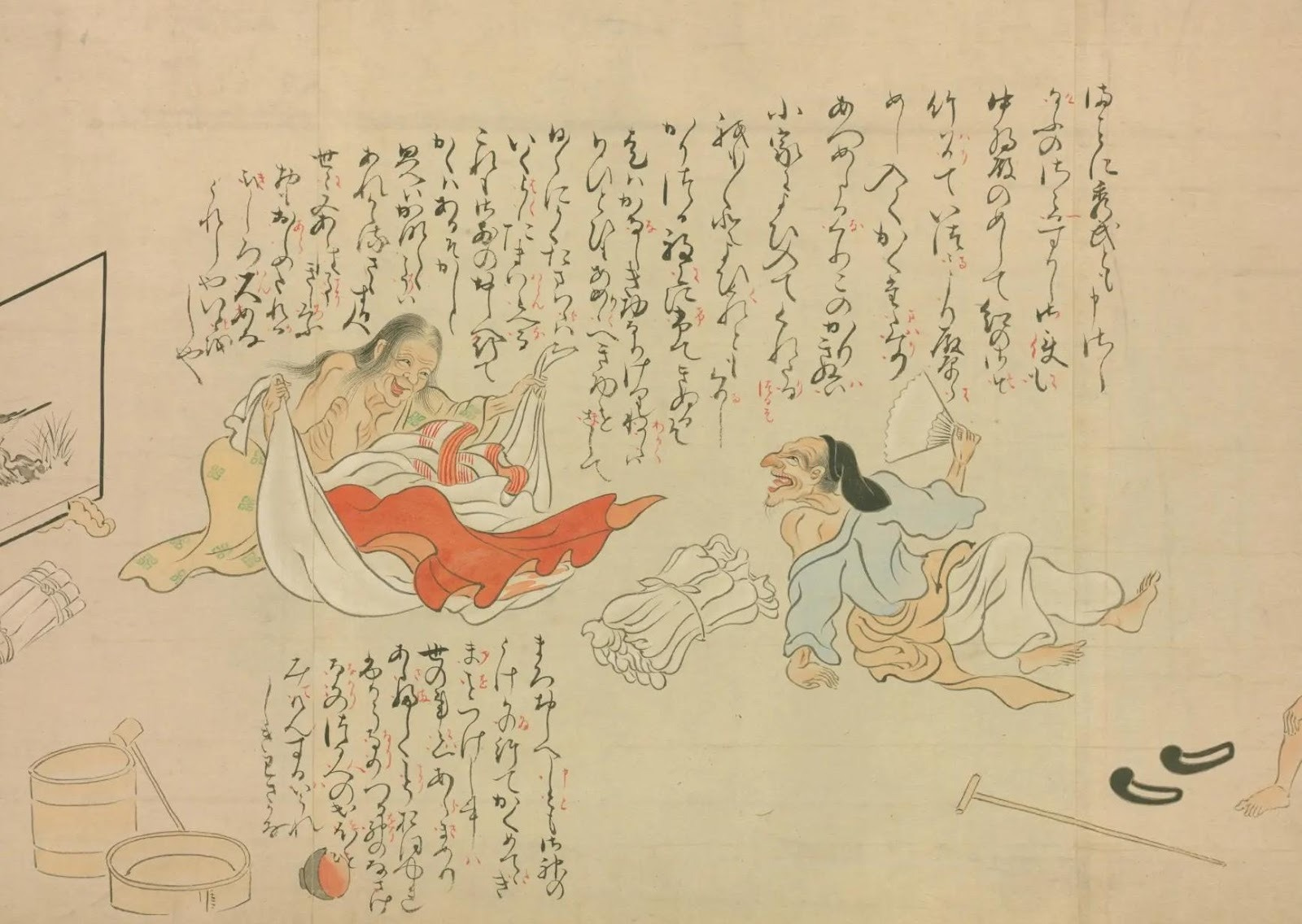
His wife opens the gifts with an enormous smile. In one day, they’ve gone from having nothing to even their farts being valuable.
He says, “Here sits the one called Hidetake. A man justly proud of his skills. I was summoned to the residence of a nobleman and received the red robe. Other nobles collected gifts for me. This hunter’s garment which I wear was a gift from someone living in a small residence.
“Many others pressed me to perform for them but I couldn’t, so I escaped. Being old is so difficult. Were I younger, I could perform all day. Day after day I wonder how much I could accumulate?”
Ever the good husband, he thanks his wife, “All of this happened because of your encouragement, dear wife. Because of this I treasure you. You are wonderful.”
His wife gives a whole speech. “There are no others with skills to match yours. If all other competitors were lined up, you would excel them all. How pleased I am! How happy!
“Although I did encourage you, this is the work of the gods. These skills are not of this earth, not human talents. I’m not the one you should be thanking. I am shocked. This is all beyond my wildest imaginings.
“When we were poor and unhappy, you complained all the time, but now your face has completely changed. The brightness of your face fills me with pleasure.
“What act of the gods caused this all to happen? We were so unhappy and despaired of even surviving the winter. We were so sad. But we didn’t give up hope and the world, beyond all our imaginings, did not end.”
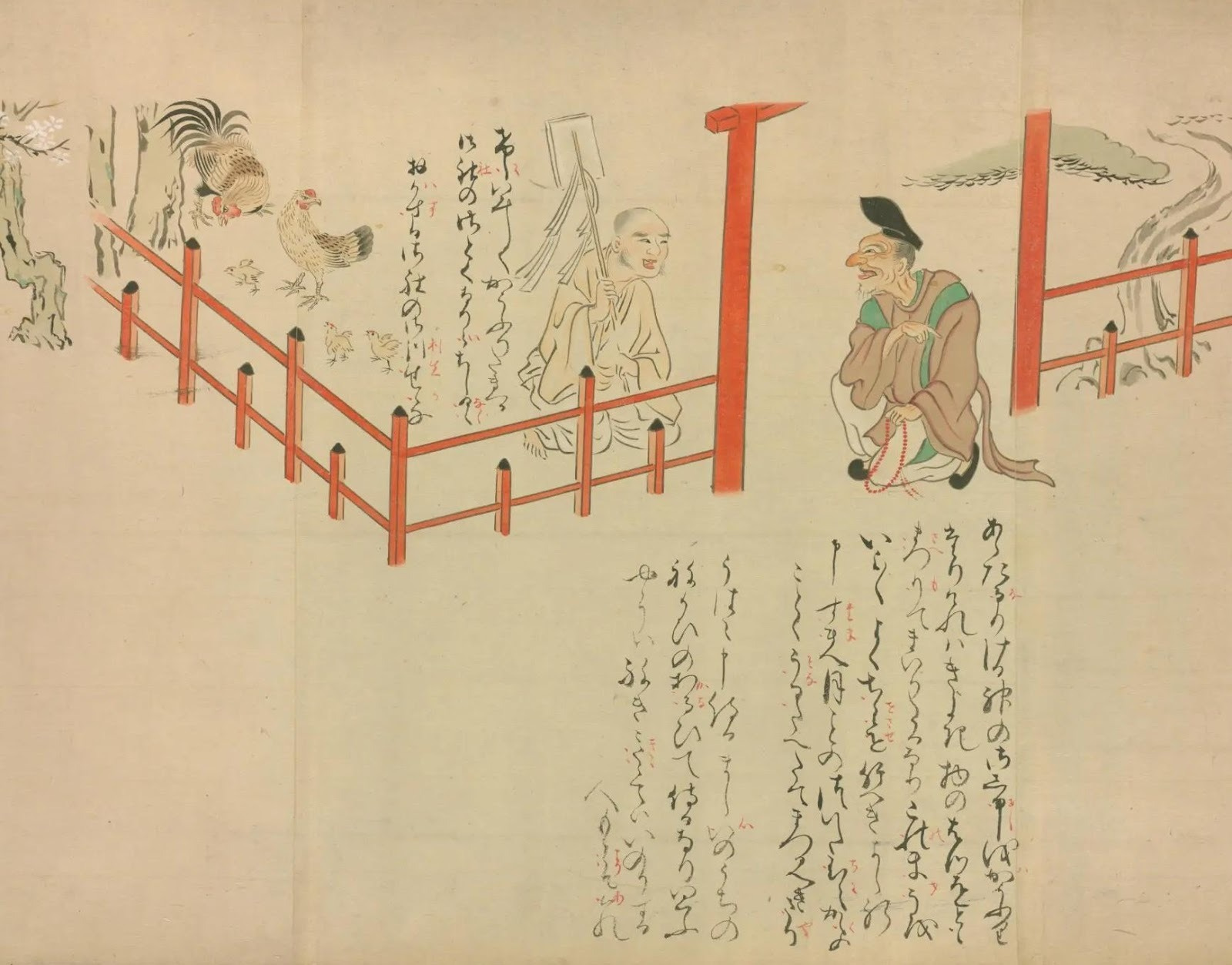
Hidetake is not a man who forgets those who helped him. He goes back to the shrine to thank the priest and give offerings.
“Because I have recently experienced a special blessing from the god of this shrine, I bring these offerings of thanks. I pray for continued success with this skill and that my talents will expand. Henceforth, I intend to make offerings on the first day of each month. Please don’t tell my wife that I am heaping praise on you. Your shrine will soon experience a new wave of supplicants. Because of you I have had great success.”
The priest replies, “Indeed, it is just as you say. You have experienced the power of the god of this shrine. You are receiving the great benefits bestowed on those who worship here. All of your good fortune is owed to this shrine.” This priest should pray for some modesty.
At this point, it seems like a heartwarming story about a poor couple who changed their lot in life. But this is only the first half of the story, the half they normally had you in.
Sometimes you find a good friend who is supportive and genuinely happy when you achieve success. Hidetake and his wife did not have one of those. The rest of Fukutomi zōshi is a story of jealousy, greed, and consequences.
Next: The exciting conclusion, it will crack you up.
References
First scroll: https://dl.ndl.go.jp/pid/2542430/1/5
Ulak, James Thomas (1994). Fukutomi zōshi.
What an uplifting story. I’m sure that even though there are jealous neighbors everything will work out fine. 🙂↕️