

An exciting end to our epic story. Part 2 is on a separate scroll and starts out a lot like Part 1, but with one big difference: they’re rich!
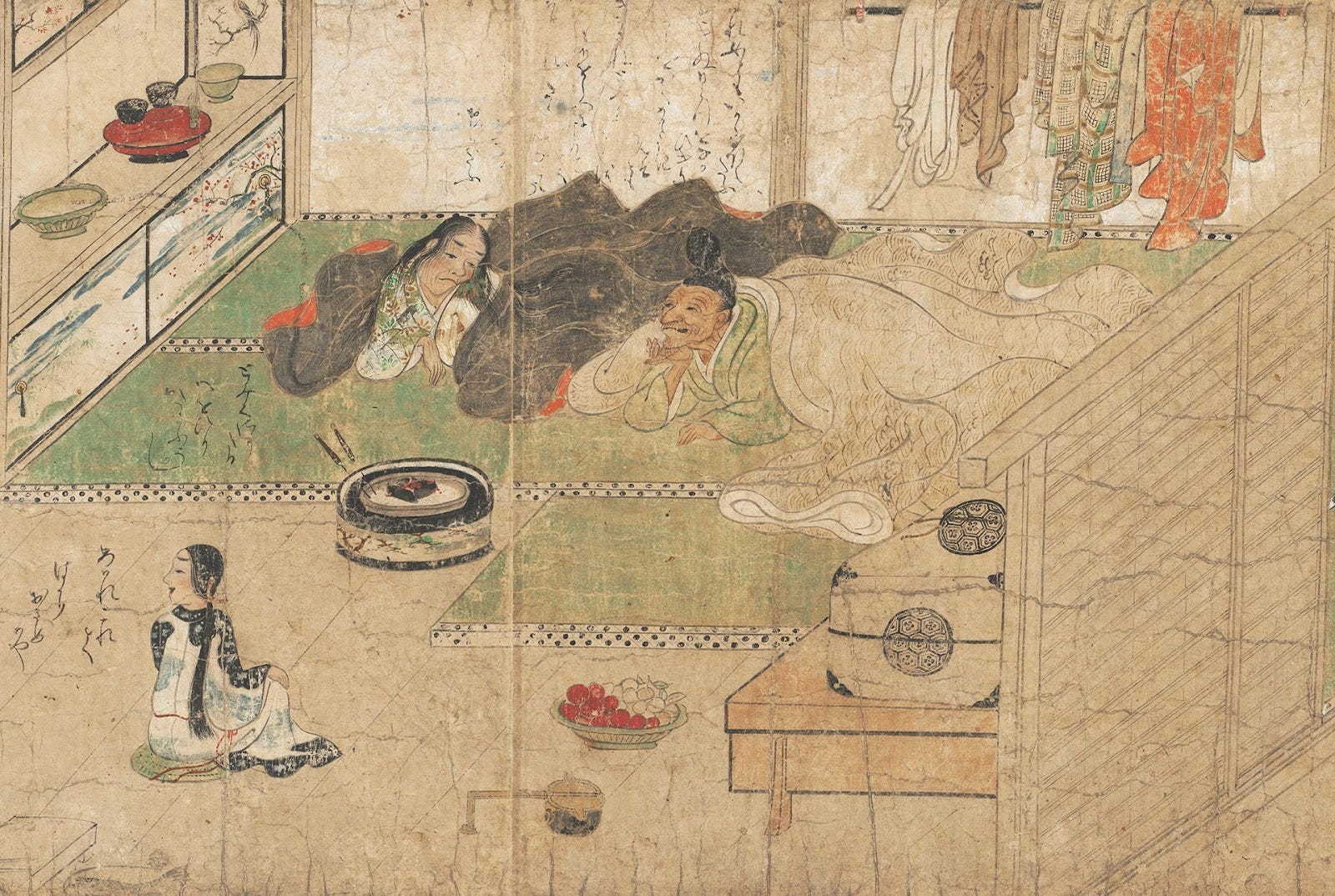
Hidetake and his wife lie on brand new tatami mats, wearing thick quilted robes. On the shelf are celadon porcelain bowls, lacquerware, and a tea set with tenmoku cups. These were all precious items from China, usually displayed in the imperial palace or the shogun’s castle.
A portable heater keeps them all nice and warm. Behind them hang fancy clothes, and in front of them, a servant.
The place looks fancy, expensive, and as tasteless as a bad case of COVID. Even the couple looks rough: him with the big ugly nose, her with the messy hair. The whole scene is supposed to be an example of a poor person who suddenly ran into wealth and immediately went out to buy spinning rims, splurge on gaudy jewelry, and fill his previously simple, white house with gold.
Hidetake says, “Think back to when we had only a single garment to cover us. Now we wear priceless garments. We’re covered in wealth. It’s thanks to your suggestion and encouragement that we have reached this level. I should sing the praises of womanly virtue. What do you think?”
His wife says, “What fortune laden farts you have produced!” Not a direct response to what he said, but certainly a response.
The couple is just rolling in dough, or rice. The servant says, “I must measure and store this rice quickly, but there is so much of it!”
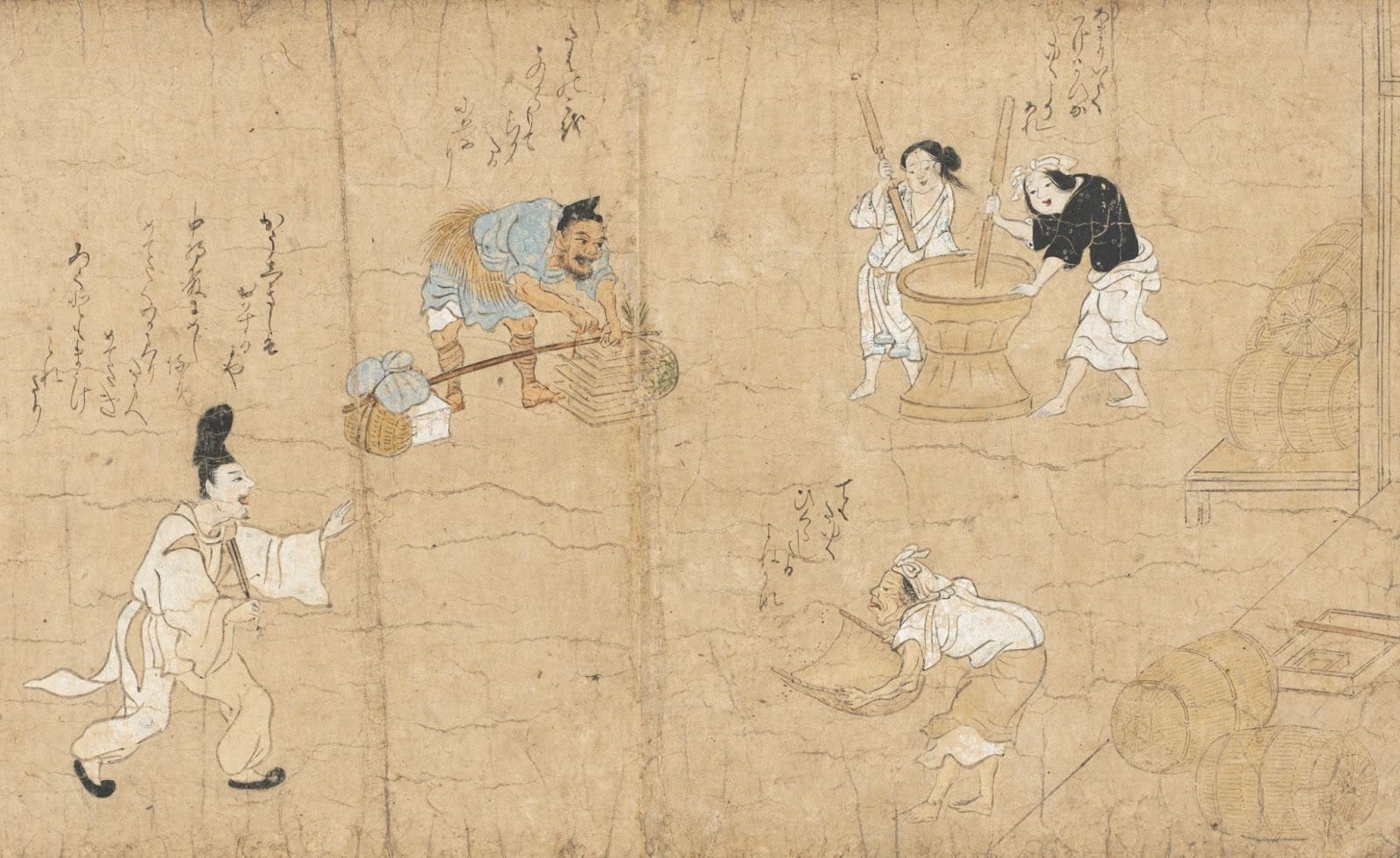
Did you think that was their only servant? Here, we see two women pound rice, another sifts grain, and a delivery man delivering things.
One of the women pounding rice complains, “I’ve been pounding so hard my arm is getting numb.” The one sifting grain laments, “My arms ache from working the whole day on this rice.” The delivery guy says, “I’ve brought this gift from the lord’s house. Its quality is great.”
A messenger at the bottom left arrives, saying, “Is the master of incense in? I bring tidings from the nobleman who requests your services. If you continue to perform well, more rewards await you.”
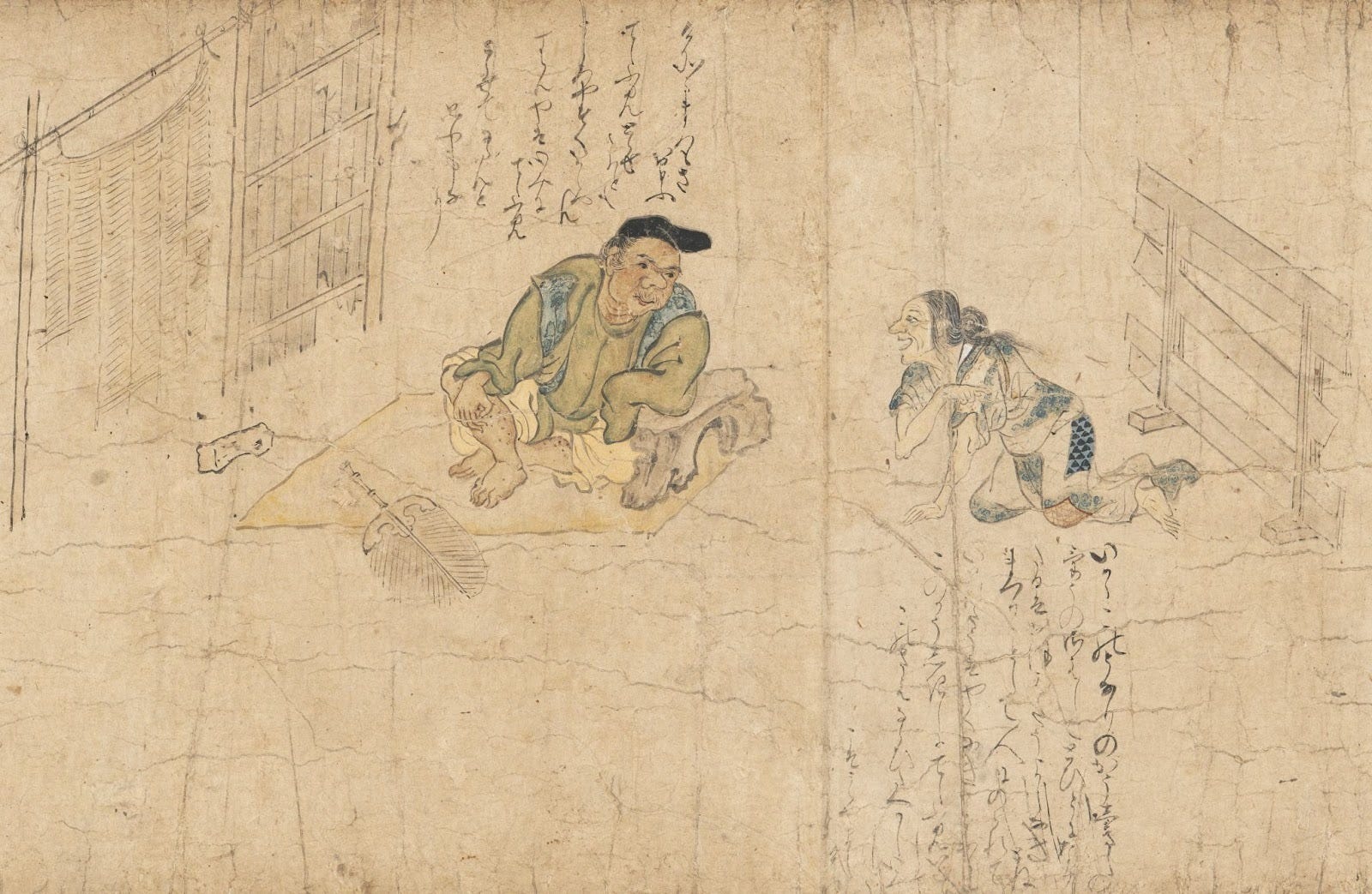
Now we’re introduced to some exciting new characters, who look as pleasant as a dead body. They’re Hidetake’s neighbors.
The wife asks, “How did that Master of Incense come by his talent and is always in demand? I can’t figure it out. But for you, a man who does everything for others, no good thing comes. Why don’t you try being his disciple, learn his skill? I really envy him.”
The man’s name is Fukutomi. “Yes, yes, I agree. I doubt he would surrender his secret that easily, but I’ll give it a try.”
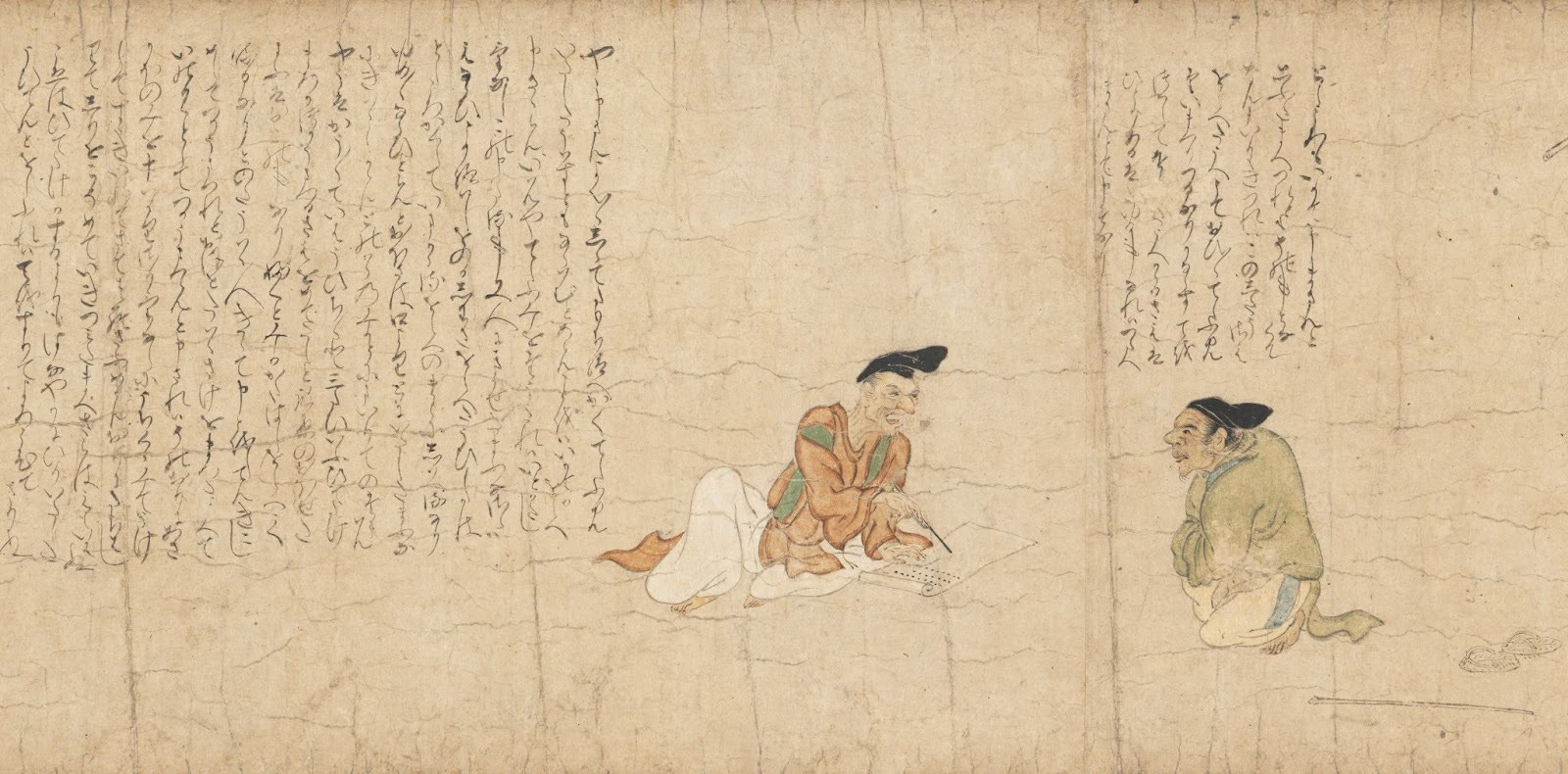
And so Fukutomi kneels before Hidetake. “For many years I’ve intended to pay my respects to you. Today I come for more than just an exchange of pleasantries. I want to become your student so that I may learn your marvelous skills. Please, no matter the cost, I ask that you do what you can. Please teach me.”
Thinking that he must make the offer enticing, Fukutomi appeals to Hidetake’s vanity. “I do this because I am worried that your talent could be lost to future generations. I can carry it on for you.”
Hidetake says, “Fine, if you desire. Learn well and maintain these skills. Don’t let me down. Don’t reveal to anyone what I will teach you, or your mastery will never be complete. You must always keep it secret. When you perform, it must be exactly according to my instructions. Remember, if you really want to master this skill, you cannot tell anyone.”
Will Hidetake really tell him the secret? Hidetake says, “Go to the house of a nobleman and recite this magic phrase: ‘koko te io pichi pichi.’”
What does the phrase mean? Nothing, actually. Seems to be some onomatopoetic words that evoke a sense of bouncy, exciting readiness.
Hidetake gives more sage advice. “To whomever greets you, tell him it is ridiculous that the unskilled Hidetake has received so much praise for his pathetic performance. When they bring you before their master to perform, tell them you need a cup of sake and recite some prayers. As you drink the sake, secretly swallow ten morning glory seeds.” This sounds like great advice so far, if you know what morning glory seeds do.
“Wait for a bit and you will soon feel an ache in your stomach. Run immediately before the lord. Hold your breath tight and contract your anus. Then the most beautiful sounds will emerge from you, more beautiful than I have ever been able to release.”
An ecstatic Fukutomi returns home, in disbelief that someone with a monopoly on the sphincter like Hidetake would present his secret wide open for another to snatch so easily.
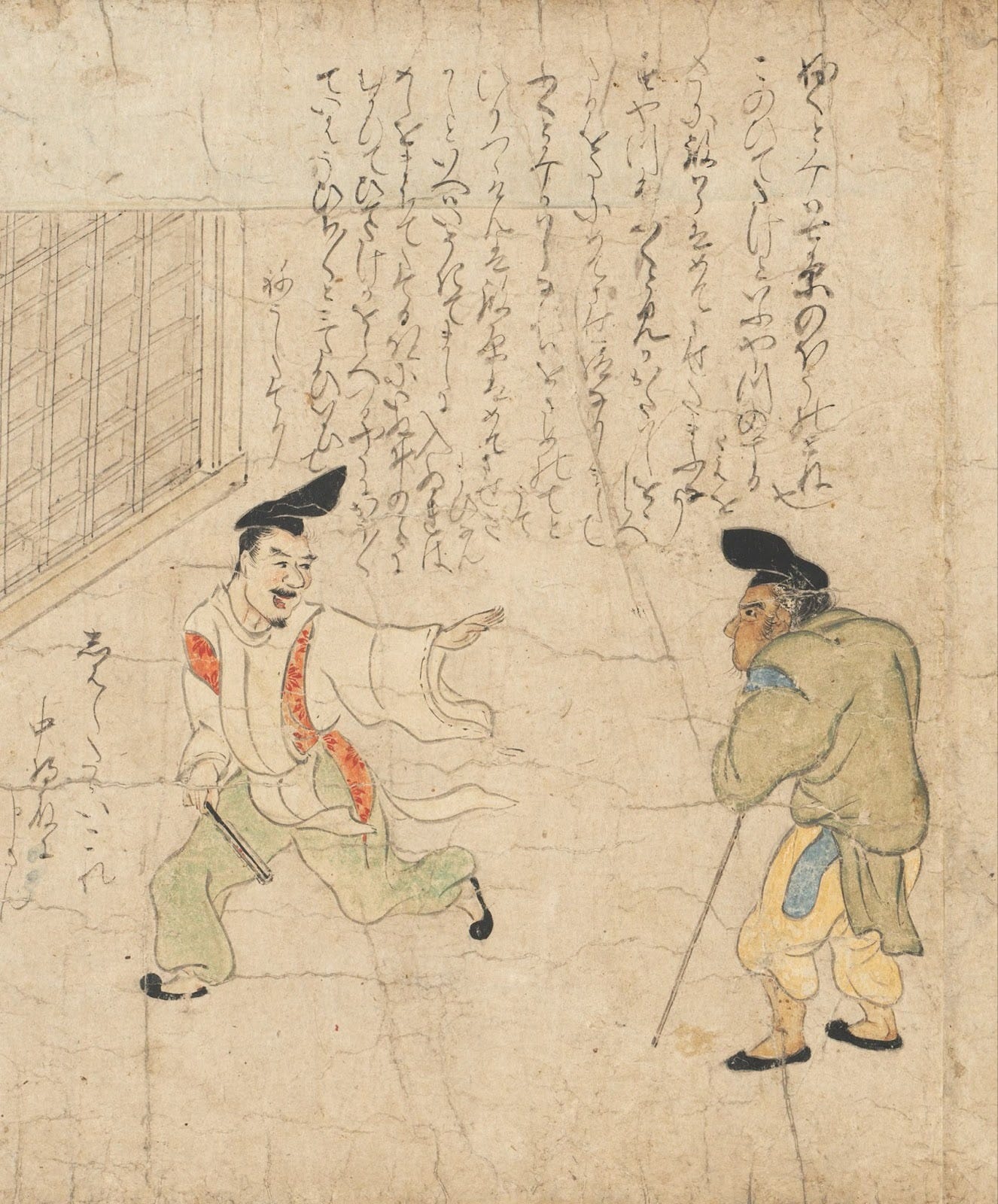
And so, after giving it a lot of thought and zero practice, Fukutomi visits the lord’s home. The servant greets him. Fukutomi declares, “I am Fukutomi, a public servant from Shichijō. I’ve heard that your master loved the performance of the man named Hidetake. He is my pupil. It was I who taught him the secrets, but he only acquired a small part of my skills. You have yet to see the best parts. If you will allow me to demonstrate, the noble people will surely love me.”
Bold claims, Fukutomi. The servant runs off to inform his master.
Fukutomi says “Koko te io pichi pichi” perfectly.
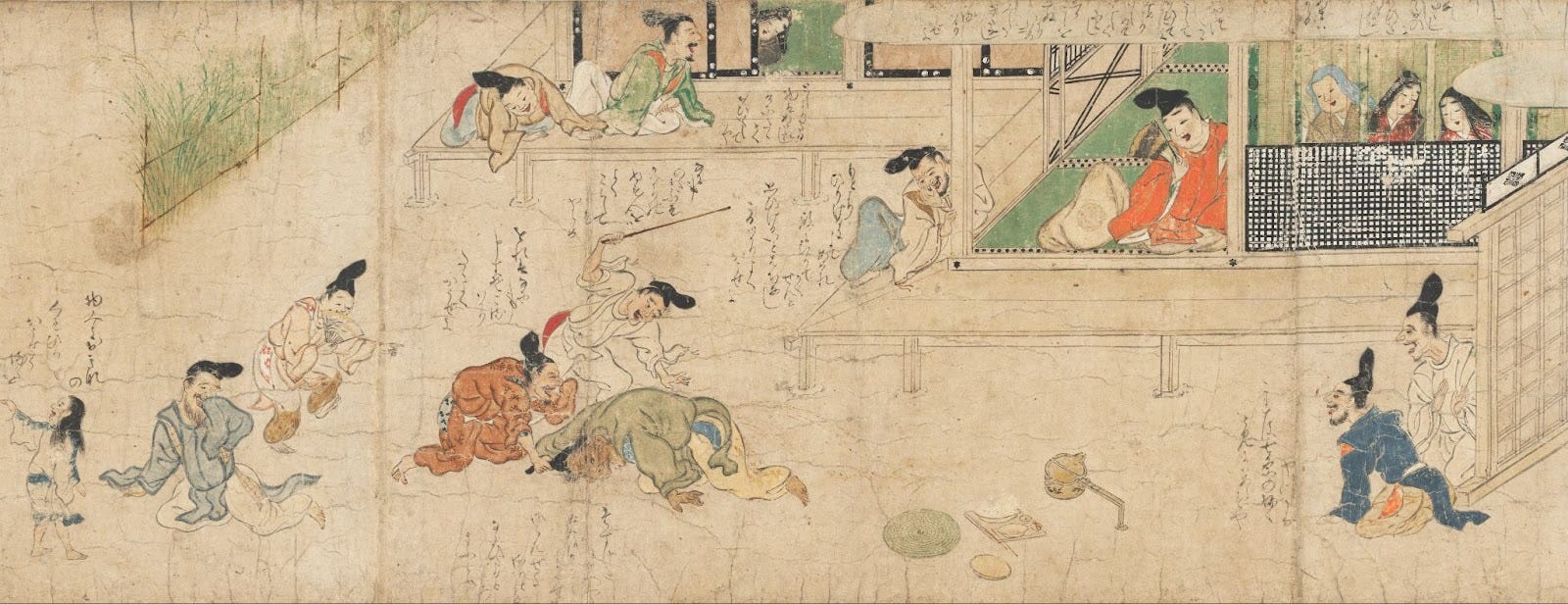
Before the lord (in orange) and the assembled nobles, Fukutomi performs the most important act of his life. The scene is a mirror of Part 1 of the story where Hidetake gave his performance, a funhouse mirror.
Fukutomi bends over, his non-magical anus making a huge mess in his pants due to the morning glory seeds. Everyone laughs at the poor guy like they’ve never seen a greedy man learn his lesson before.
One woman on the right says, “What a horrible thing! Throw him out, my lord!” Another woman, at the top, says, “He is only a sorry old man. Just get him quickly out of my sight.”
The lord turns out to be pretty vicious. “Beat this fool and drive him out. Even his face is hateful and disgusting. Stomp on his hips until he is within an inch of dying. He’s filthy! Beat him until he learns his lesson.” An attendant happily bashes him with a cane.
The guy next to the lord holds his nose. “How shocking that he would dare come before our master and act like this. What a shameless fellow. Beat him to the point where he would never again think of doing such an outrageous thing.”
Fukutomi must be illiterate because he can’t even read the room. Instead of running out of there, Fukutomi says, “Please help! Please stop and let me try a bit more. I have so much more talent to show you.”
One attendant can’t believe what he’s hearing. “What do you mean? We’ll pound you until you get this lesson straight!”
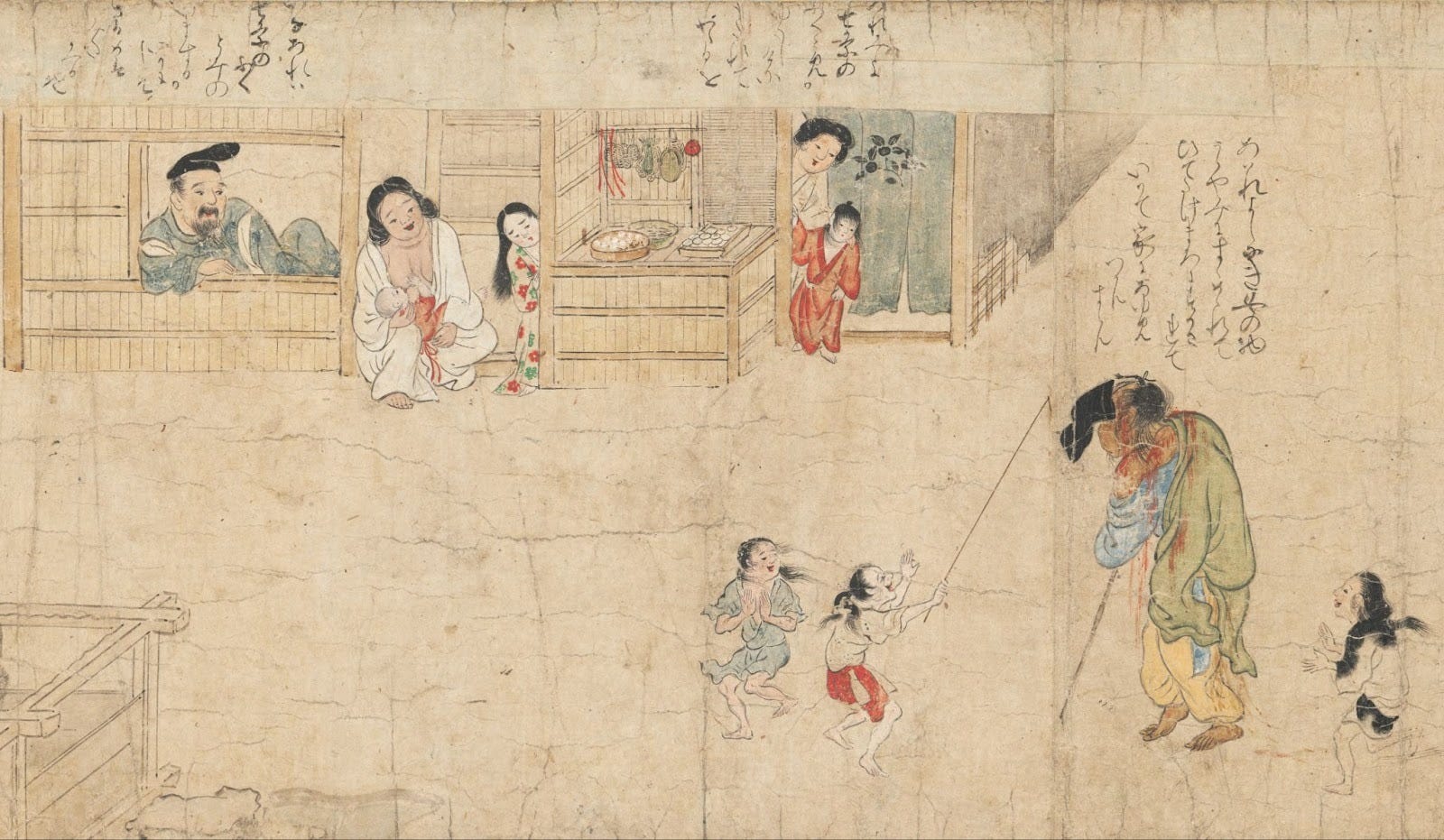
Fukutomi walks home, reeking, bloody, and defeated. Seeing him in this state really affects the townsfolk, and they come over to help mock and laugh at him. The children say, “Look at that! The pooping and farting old man has been beaten.”
At the food shop, someone says, “Look! It’s Fukutomi of Shichijō. His good fortune was star-crossed. He was beaten.”
The man on the left says, “Oh no! It is indeed Fukutomi of Shichijō. How could such a fate have befallen him?”
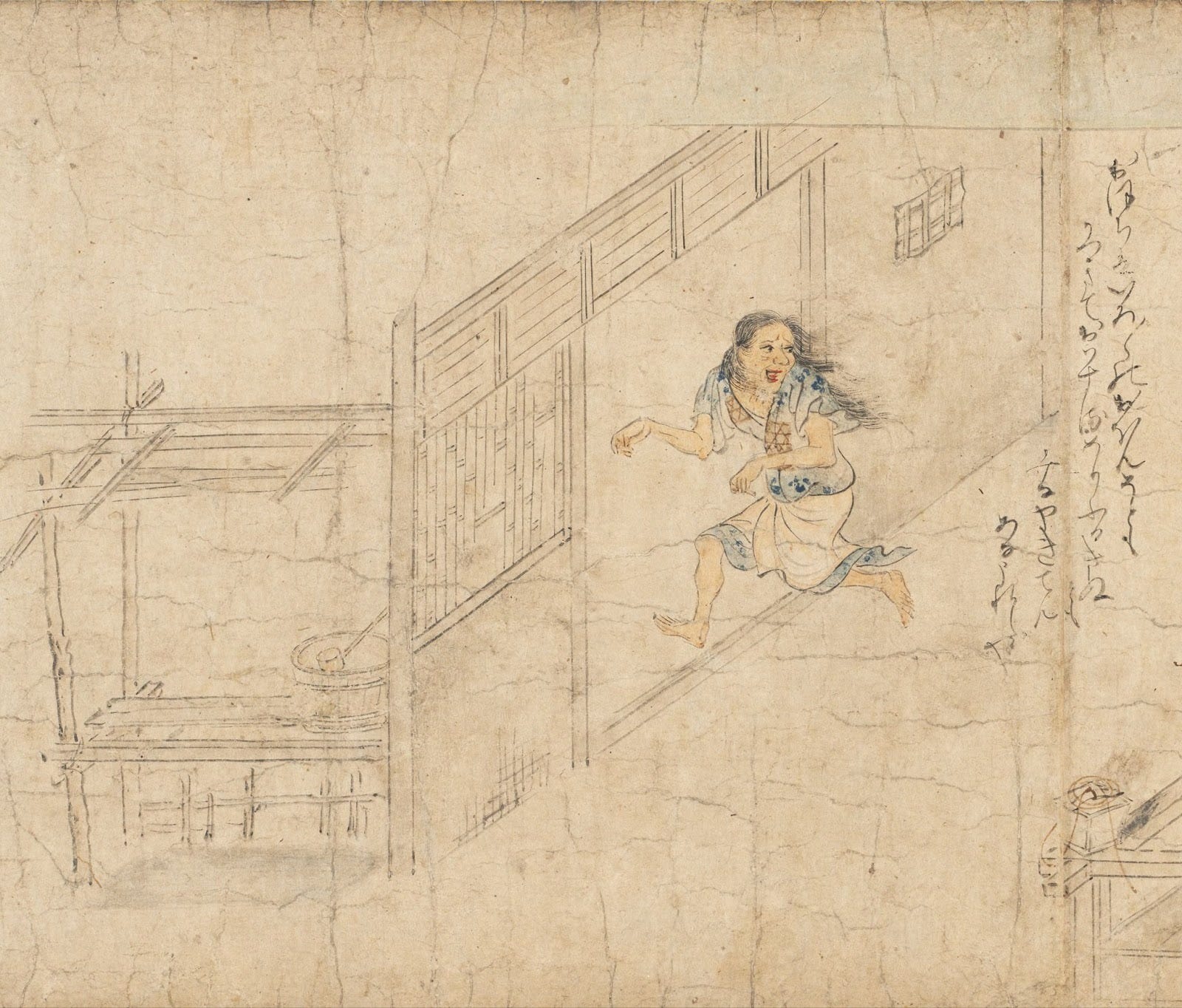
Fukutomi’s wife sees him in the distance. She gets super excited and demonstrates that you shouldn’t count your chickens before they come home, or something. “My husband has been rewarded with beautiful colored clothes. I’ll burn all his old clothes, then. Oh, I am so happy!”
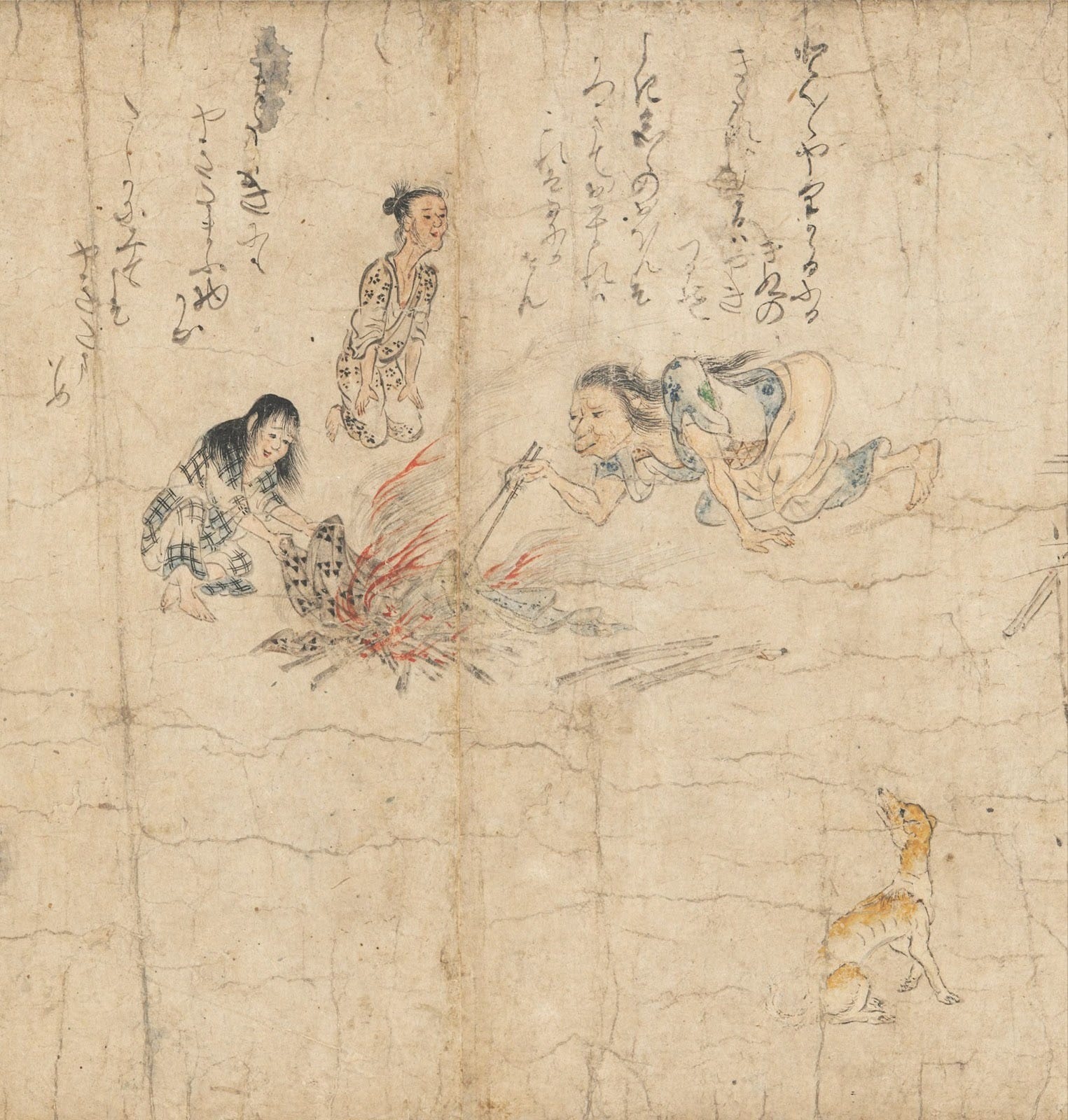
She actually burns all his clothes, the madwoman. “Burn these quickly, these filthy old things,” she says. “Keep burning. He has been given the most beautiful garments and won’t need these anymore.”
A young girl helps. She’s probably their daughter.
The neighbor at the top left is the sole voice of reason in this whole story. “Aren’t you being a bit hasty burning these things? Shouldn’t you wait, to be certain?”
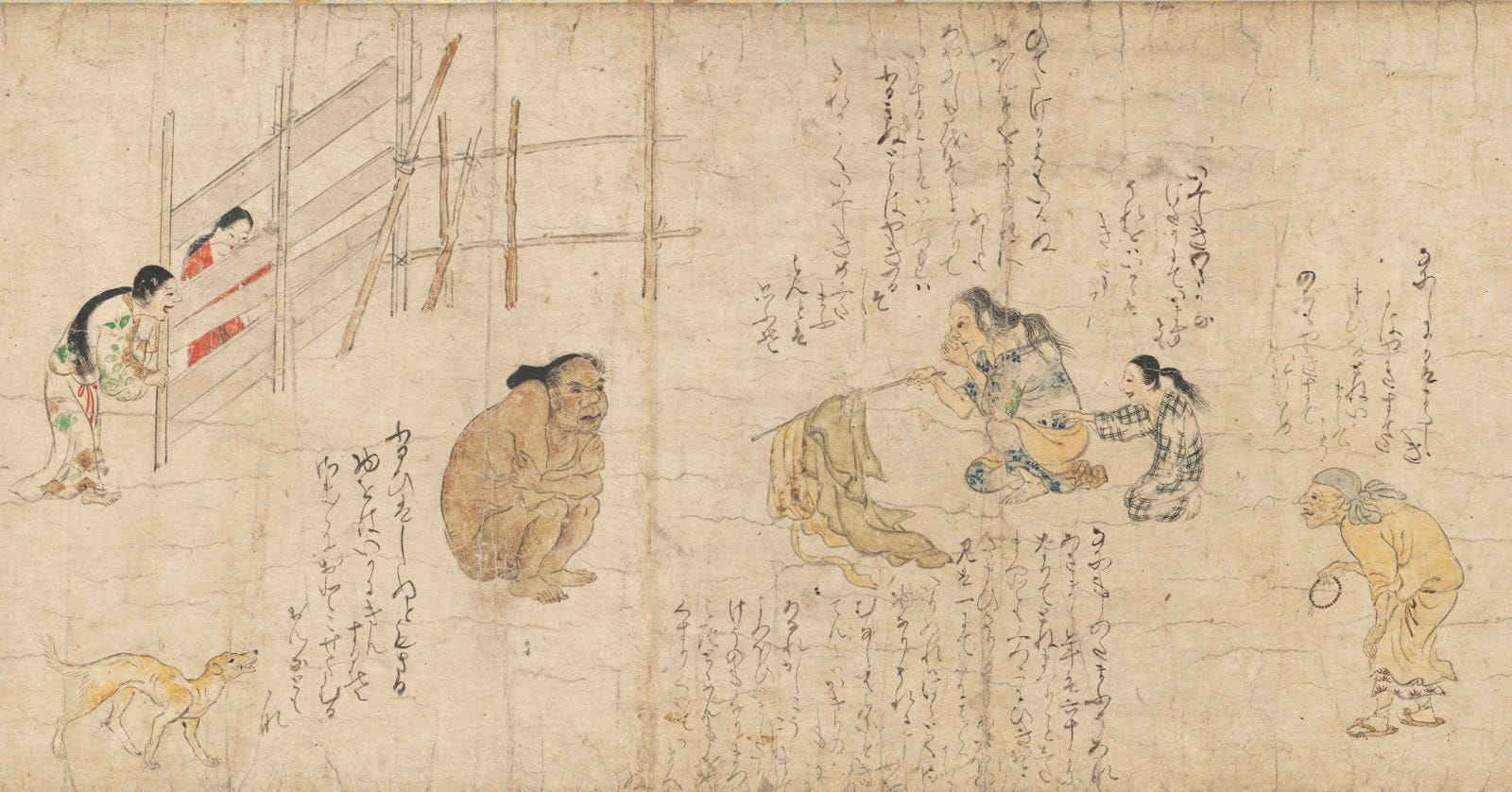
The next scene shows the aftermath. Fukutomi’s wife complains, “How disgusting! Look at these dirty things! How could you wear them? It’s better to sit naked.”
His wife uses a stick to remove his poop-covered robes. An elderly nun states the obvious. “You burned his things too soon. You should have waited until he came back.”
The wife explains, “Hidetaki was given such beautiful clothing. I thought that you would receive luxurious brocades and satins. So of course I burned your old robes. Who could have guessed you would receive such horrible treatment?”
She goes on while Fukutomi sits naked and shivering. “What ridiculousness are you spouting about? You are a man of standing over sixty years old, but you act like you’re three. Everyone knows eating even one morning glory seed can cause diarrhea. Obviously, eating ten on an empty stomach would cause disastrous results. I’m surprised you were able to make it home. Take some medicine to try and calm your stomach.”
Fukutomi does not take this sitting down and launches a diatribe. “Though I’m almost shivering to death, I could never put on those filthy rags. You foul faced old woman. Woman, you’ve caused me grief. You should have at least waited to see the results before burning all my clothes.” Fair.
“I told you this would be a hard skill to master, but you insisted. I followed your advice not thinking that you would lead me astray. I wanted to be his student and he seemed happy to go along. I believed him. But now I realize why he kept stressing I needed to keep the art a secret. If I had mentioned the part about the morning glory seeds to anyone, they would have urged me to stop with the whole business. Oh, it’s okay for Hidetake to play his little game since he was the one given the gift. I was stupid for even attempting to copy him.”
All things considered, Fukutomi seems to be taking it well.
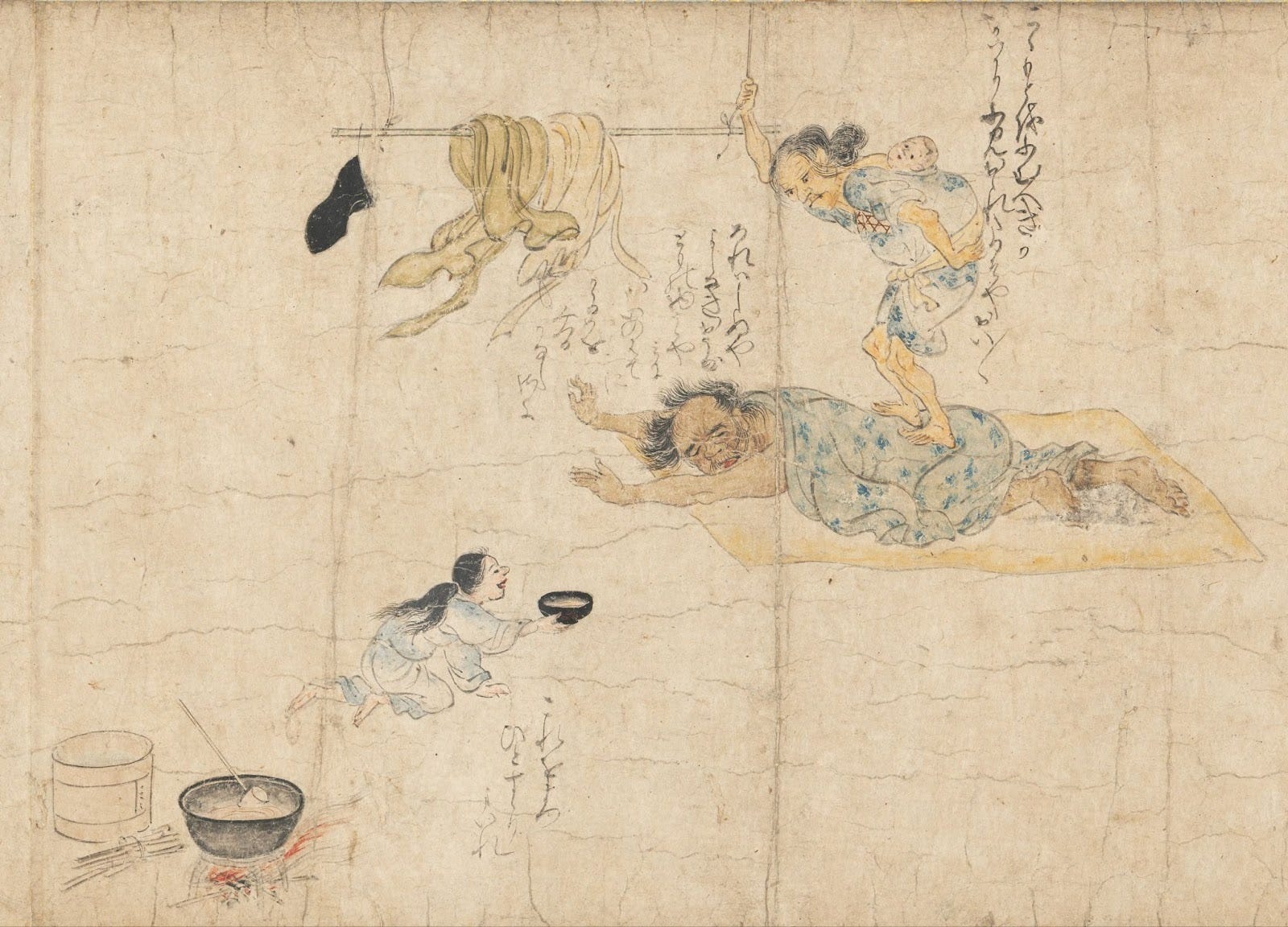
I never would have guessed that Fukutomi’s wife is an ashiatsu masseuse. She steps on his back, saying, “Is this where you want me to step? Oh, my poor man, how many times did they beat you?”
Fukutomi is in a bad state, and still hasn’t forgiven her. “Oh, I feel like I’m dying! You silly old woman! This is because of your envy. Is this the fruit of my old age? Is this what has become of me? How terrible!”
The young girl gives him some soup or medicine. “Please, take a sip of this.”
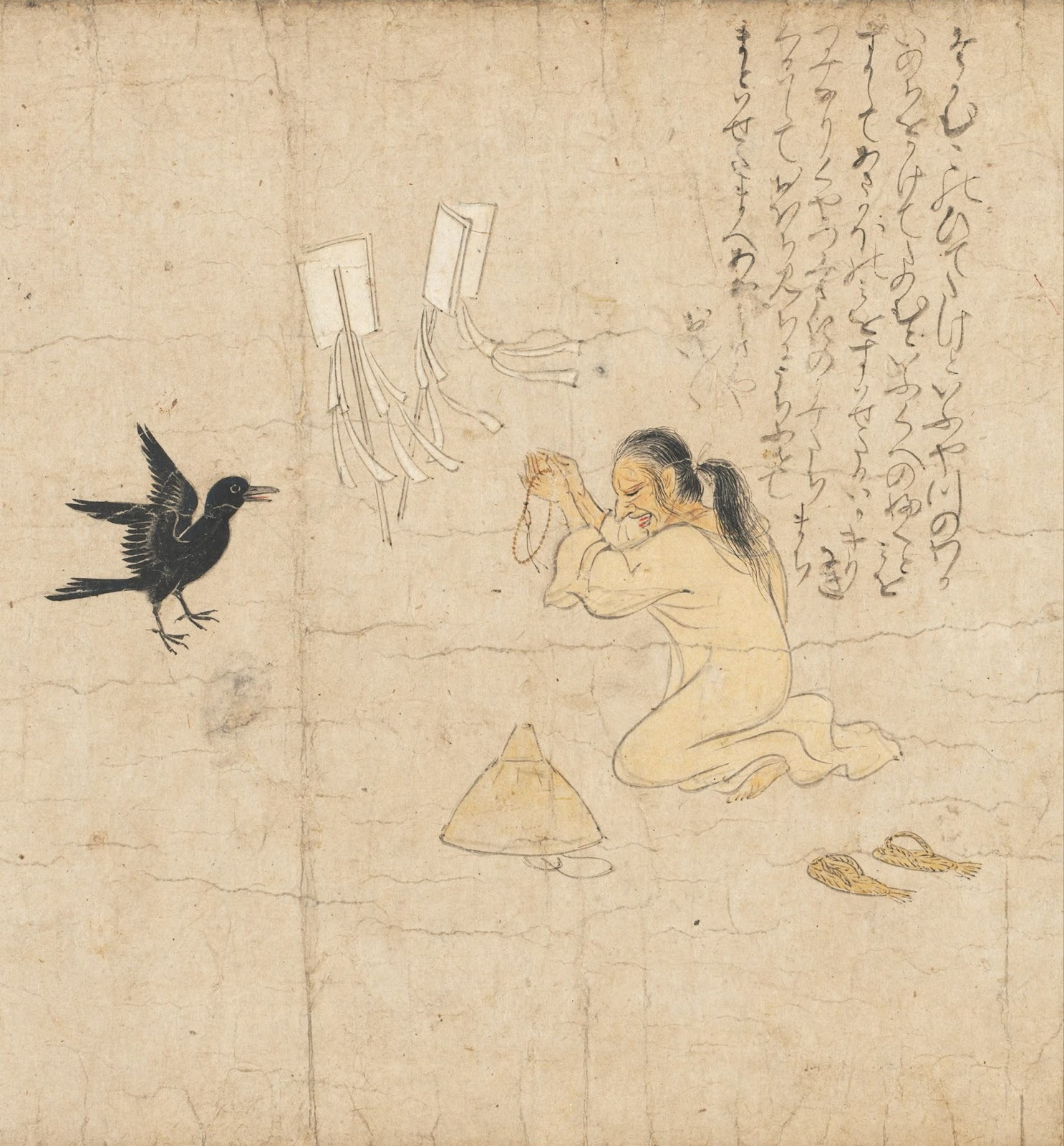
The wife kneels, praying. A crow stands before her. It’s supposed to be an incarnation of a god of fortune or one that oversees the future. If you think she’s praying for her husband to recover, that would make sense. But you’d be wrong.
She says, “The man named Takamuko no Hidetake tricked my husband. Give this man to me. Give me his life. He told my husband to eat morning glory seeds. His sin is vast. Confuse his protecting spirits so he may lose favor and end up in the streets like a beggar.”
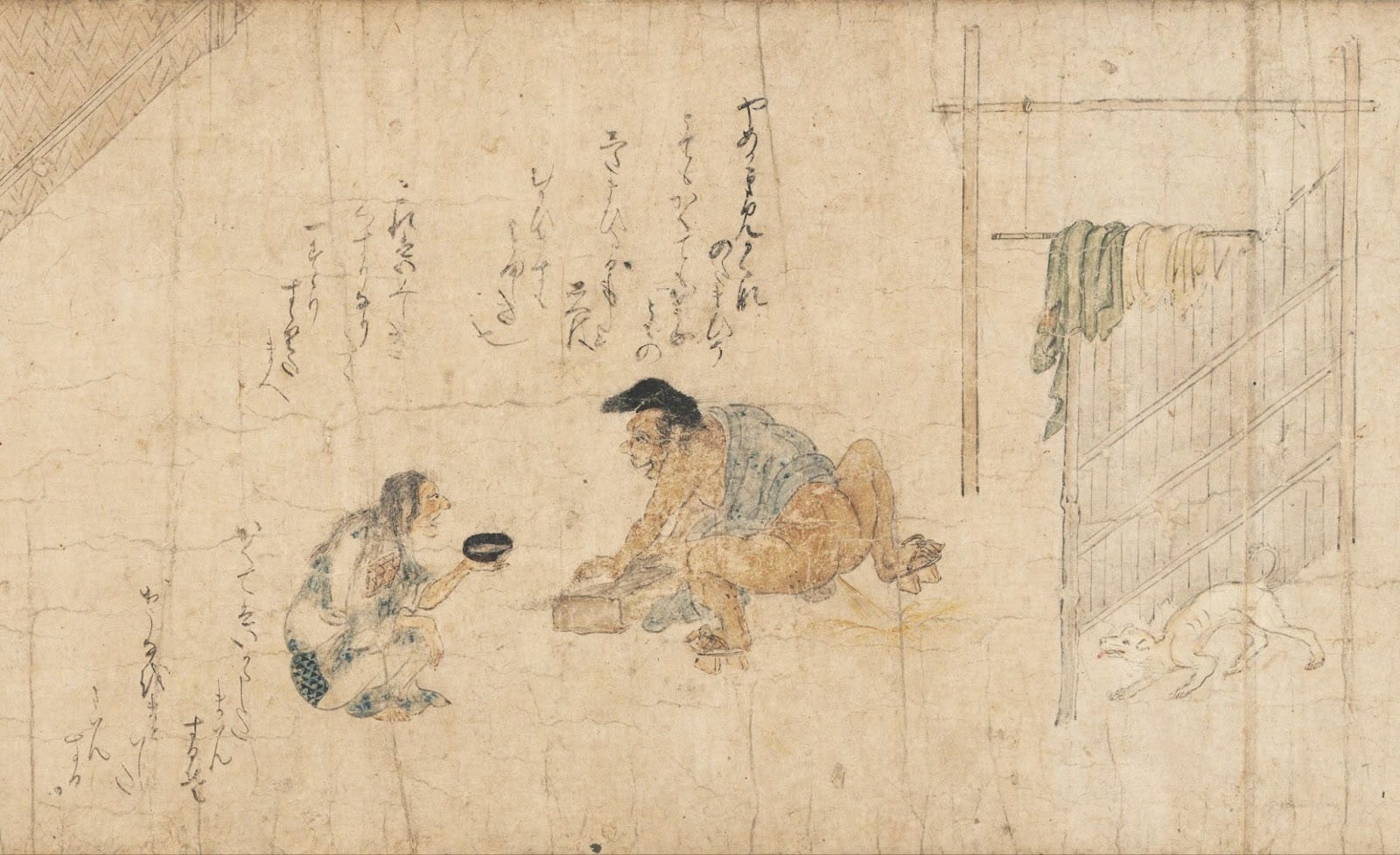
Sorry if you’re eating while reading this. Fukutomi takes a heavy bio break while his wife gives him a cup of medicine. She says, “This is good medicine. Please just take a sip. How can you pull yourself together and get on with things if you are so fixed on that notion? Do you want to drive this poor old woman mad?”
Fukutomi says, “You! Don’t say anything. Whatever it is women do, I can’t take it. I can’t even look at your face.”
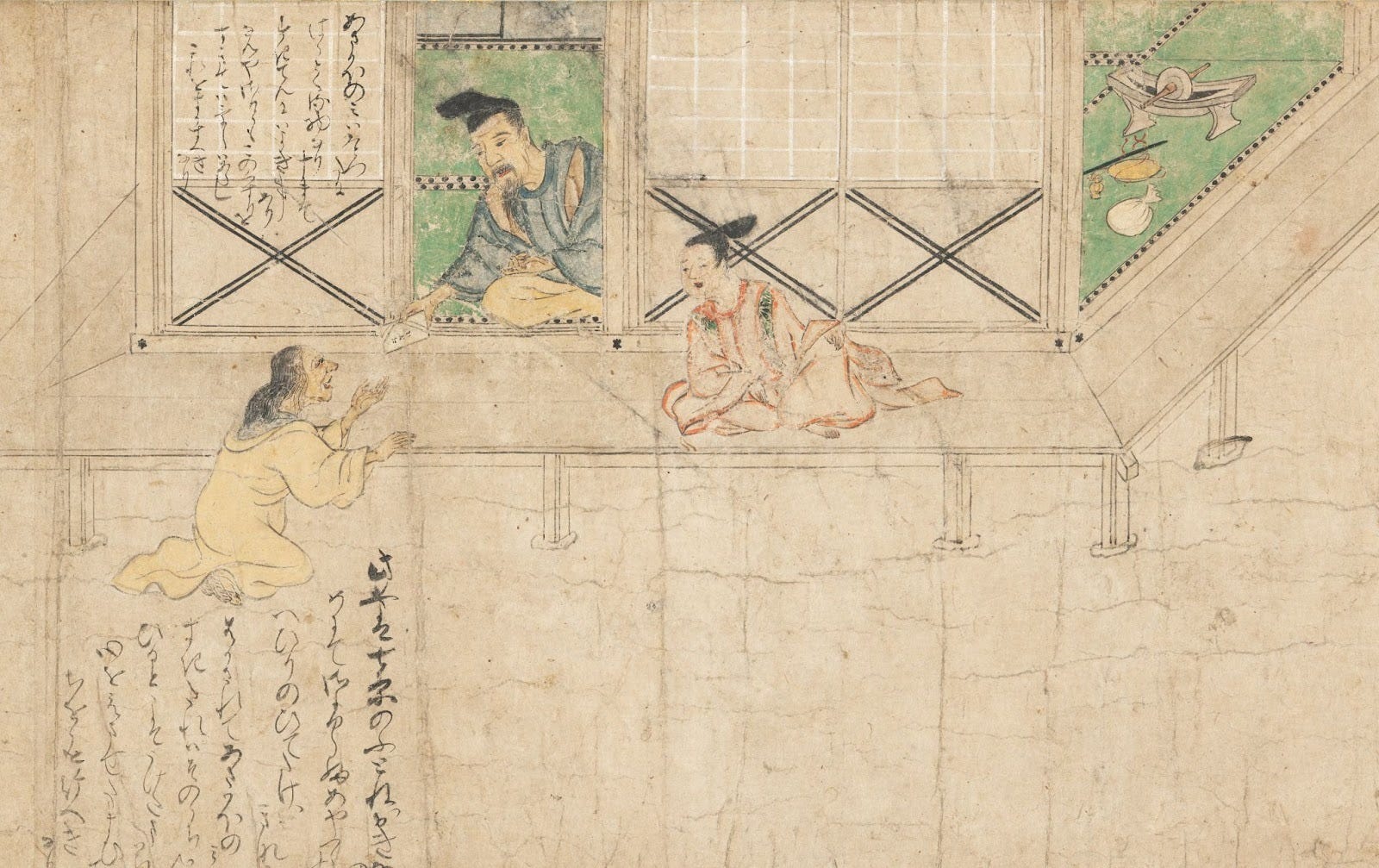
Fukutomi’s wife gets some medicine from a doctor.
The attendant on the right says, “This is the wife of Fukutomi, a leader in the community of Shichijō. He was tricked by the farter Hidetake into eating morning glory seeds and now suffers from diarrhea. Based on the symptoms, please prescribe a treatment.”
She says, “This man deceived my husband into eating ten morning glory seeds. Now he must endure loose bowels. It flows from him like water. He is old and suffers so I beg you for a cure.”
The doctor laments, “Even one morning glory seed can cause an upset stomach. Imagine what ten can do. Give him this medicine. It can’t hurt.”
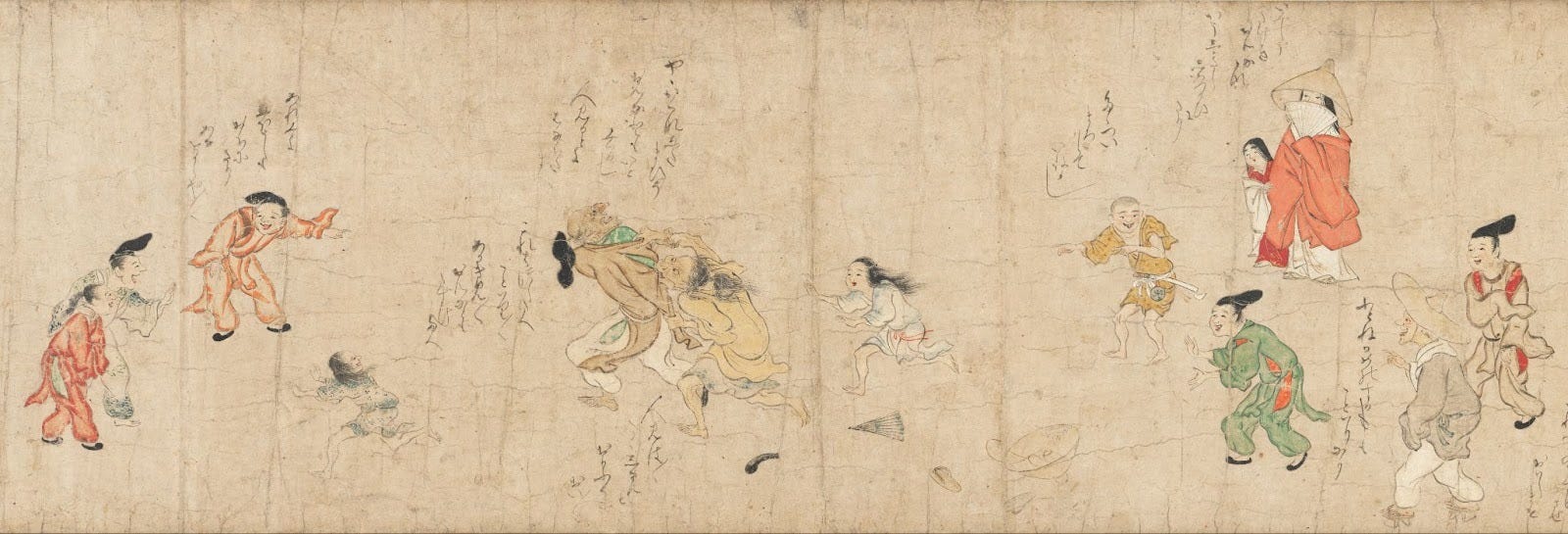
Fukutomi’s wife cannot bear her husband’s suffering and decides some payback is in order. She attacks Hidetake, tearing his clothing with her hands and teeth. Hidetake struggles to get away from this crazy woman.
She screams, “Let them see! Let them look! Maybe I’ll die doing this. He! He!” Hidetake says, “Please, stop this! Decent women shouldn’t behave this way. People are watching. Please let go! Take your hands off me! I give up, I give up! Madam, please let me go. Ladies, help me!”
On the right, a man says, “Fukutomi’s wife is entirely justified.”
Also on the right, a woman watches with her daughter. “What a wild woman! The incense master can’t handle her.”
A man with a shaved head says, “What’s going on? Can’t she just flip him and throw him to the ground?”
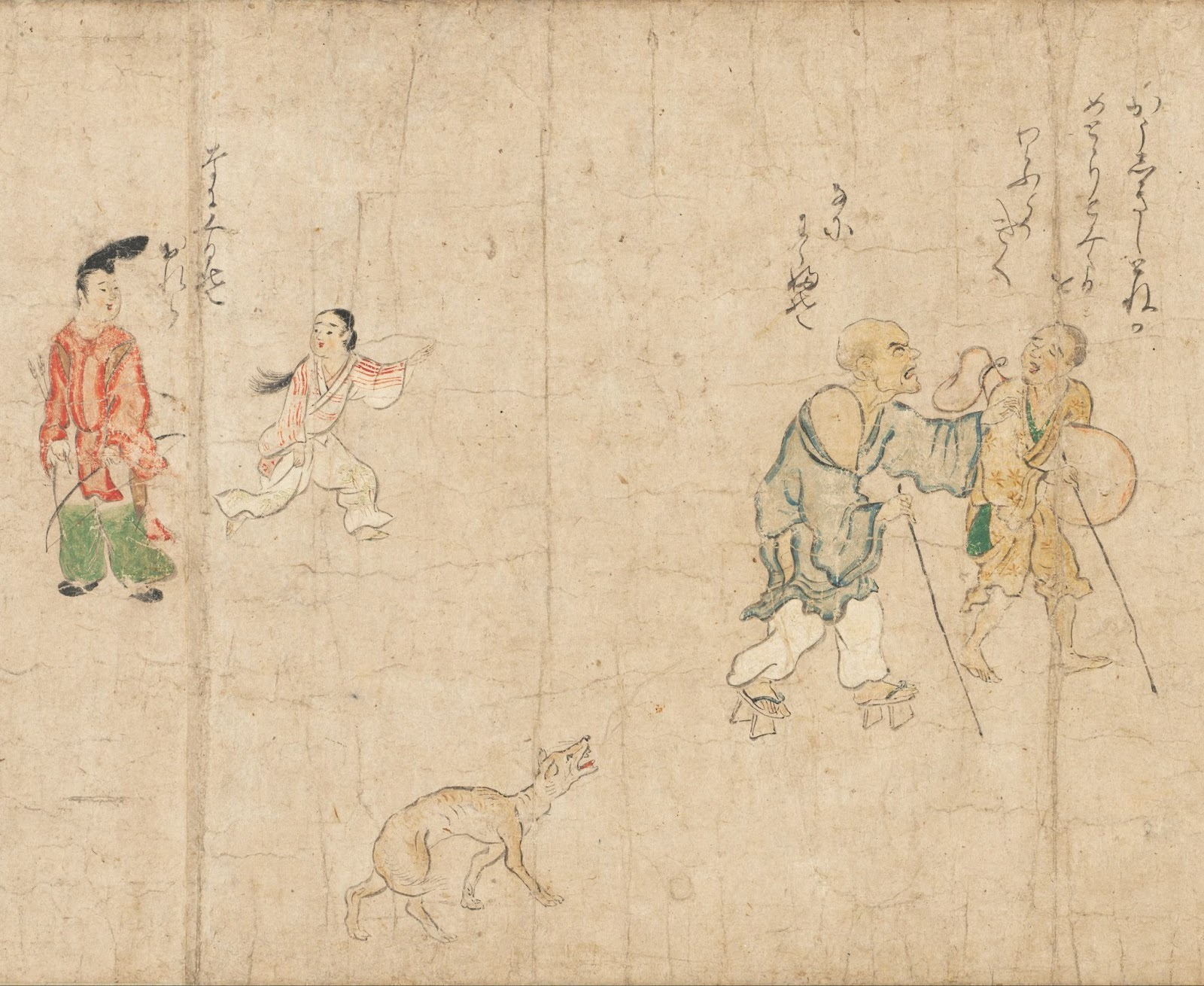
On the left, someone asks, “What are they looking at?”
One monk asks his companion, “What’s all the laughter?” The other monk responds, “I think they are laughing at the incense master and Fukutomi’s wife.”
What’s it all about?
Besides being a funny, poopy story, Fukutomi zōshi is also a story about gekokujō 下剋上. The term dates back to the Kamakura period (1185 - 1333). It was a known story trope that means those of a lower position overthrowing those of a higher position.
In Japan, the social ladder was more like a pole slathered with oil. But the times, they were a-changing, and some people were a-angry about it. It was a time of social change, where an overconfident emperor tried to take power from the warriors, then was overthrown by other warriors.
In the story, two lower-class couples sought to rise above their station with as little effort as possible. And when Hidetake and his wife become rich, they immediately decorate their place with all sorts of expensive and loud items. Like many newly rich, they have no taste or modesty.
It satirizes people who are religious for their own gains. Both couples pray to benefit themselves. It also mocks nobles who spend their time enjoying useless and obscene hobbies, like those at the noble’s residence who gather to watch a dude fart while dancing.
Behind the smell lies also a message against the changing culture of Japan in the 1400s. A warrior class was rising in the countryside and they were bringing their vulgar customs to the capital, to the chagrin of this story’s author who preferred his culture less agricultural.
For example, dog hunting and dengaku dance were trending in the Kyoto capital. The story seems to compare dengaku to fart performances. Hidetake’s dance does sort of look like dengaku dances.
Part 1: HERE (in case you missed it)
Something else vulgar.
Want some awesome charms, stickers, T-shirts, and more? Check out my shop!
References
Second scroll: https://www.clevelandart.org/art/1953.358
Ulak, James Thomas (1994). Fukutomi zōshi.
I was scared to click on the "Something else vulgar" link. I was worried it was the video of the giant centipede eating a snake that I absolutely was not supposed to watch and I watched anyway 🫣