

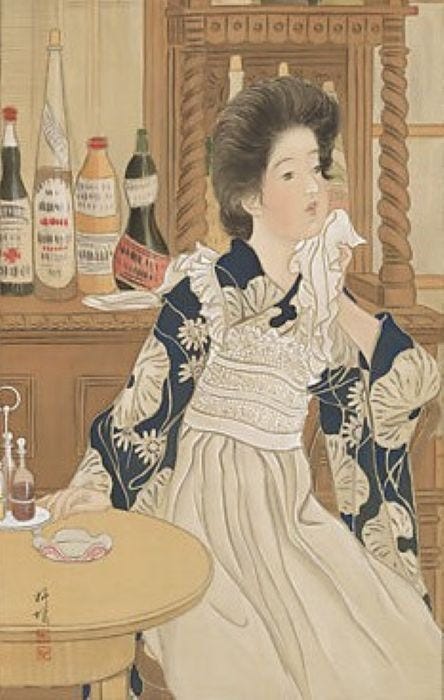
Who doesn’t love a little spice with their pumpkin latte?
In the 1920s, women had all sorts of new, exciting opportunities. Apart from farmers, geishas, and housewives, they could now also be factory workers, typists, telephone switchboard operators, and café waitresses!
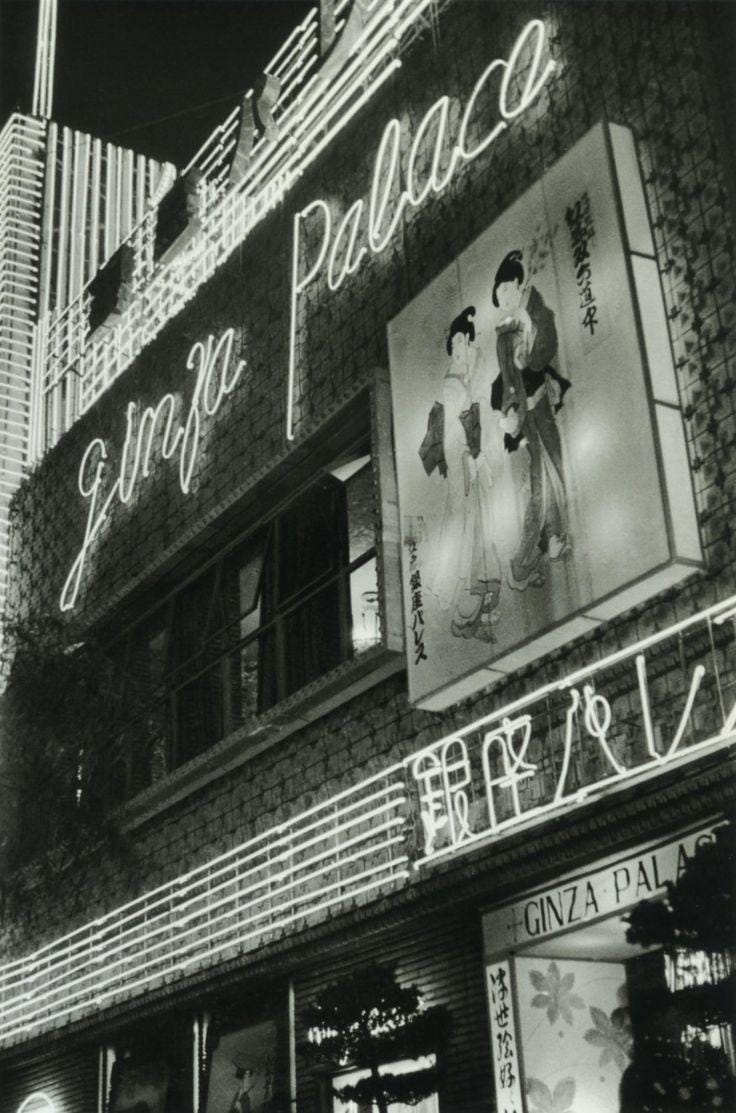
As we’ve seen before, cafés were starting to get popular in Ginza in the early 1910s, but things really took off after the 1923 Great Kantō Earthquake. Large parts of Tokyo were destroyed, but death and misery were apparently fertile grounds for coffee. Cafés popped up everywhere.
A lot of the money for the rebuilding came from Osaka, and with it came some of Osaka’s louder, brasher style. Like neon lights, jazz, and the cinema, the new cafés were trendy, fastpaced, and sexy. With these new cafés came a new type of café waitress.
Waitresses were called jokyū 女給 (the kanji literally mean woman & salary, possibly short for 女給仕, female waiter, or woman-salary-service).
If you think this means jokyū were paid a fair wage, then the jok’s on yū. Jokyū received salaries so low they were sometimes nonexistent. If you try to tip in Japan today, you get panicked looks and the bills handed back with an apology. If you didn’t tip a jokyū in the 1920s she’d never talk to you again. Because she’d starve.
Jokyū had to pay for their own work outfits, laundry, and food. And the salary of the kitchen staff. Oh, and they paid for any food or services their customers consumed: if the customer dined and dashed, it wasn’t the café owner that got stuck with the tab, but the jokyū. Finally, because such a cushy job had to have some downsides, café owners would fine jokyū for being late and charge them for any crockery broken by a customer.
In the 1920s, jokyū began offering more and more…intimate services. Why the sudden sexification?
First, the tipping culture. Jokyū earned about the same amount as a female typist, which was about half of an entry level male government clerk’s salary. They were as thirsty for sponsorship as YouTubers, and their Raid: Shadow Legends and BetterHelp were slightly dodgy male customers, so Jokyū had a far better deal. An extra smile or a casual touch, and NordVPN-san was willing to sponsor another kimono!
Second, the influx of Osaka money and culture. In Osaka, there were closer, friendlier relations between customers and staff. Many jokyū stopped wearing aprons, started speaking to customers like a friend or a girlfriend would, blurring the lines.
Some Tokyo cafés expressly advertised that their jokyū were from Osaka. In 1930, Bijinza Café (Beauties Café) lived up to its flashy, modern, sky-age image by flying in thirty jokyū from Osaka as an advertising stunt.
Third, intense competition between cafés, especially once the Great Depression hit at the end of the 1920s. 1929 also brought the beginning of a government crackdown on some of the more non-coffee related activities, among them jazz, dancing, and sex. So in one year, there were suddenly fewer customers with money, and the tools to attract the remaining customers were partly outlawed.
Larger cafés were mostly able to continue operating (often because they were in “entertainment” districts where the new laws did not apply), but smaller cafés were forced to change. Some tried to stay clean, turning into soda fountains or restaurants, but many went underground and screwed their customers. For money.
Small café owners “encouraged” their jokyū to offer more and more erotic services. A popular service was the slit in the skirt through which a customer was allowed to slip his hand.
Remember that Café Puratan was founded in 1911 for artists and intellectuals to talk about muse-worthy things. It’s nice to know that in the 1920s this legacy wasn’t entirely forgotten. The orugan sābisu オルガンサービス (organ service) was a respectful link to this artistic past: a jokyū would lie across the laps of several customers, who were then invited to touch her body wherever they wished. The waitress would then sing appropriate notes, like an organ keyboard. A beautiful expression of the musical arts.
References
Seidensticker, Edward. Tokyo Rising: The City Since the Great Earthquake. Harvard UP, 1991.
Tipton, Elise K. “The Café: Contested Space of Modernity in Interwar Japan” in Being Modern in Japan: Culture and Society from the 1910s to the 1930s, U of Hawaiʻi, 2000, pp. 119–136.
Tipton, Elise K. “Pink Collar Work: The Café Waitress in Early Twentieth Century Japan.” Intersections: Gender, History and Culture in the Asian Context, Issue 7, March 2002. https://doi.org/10.25911/EYWE-1Y58
White, Merry I. Coffee Life in Japan. University of California Press, 2012.
I love your writing style.