

This is the true story of a man who chased his dreams, and found it was a nightmare.
Last time we ended with Hokodo in Kobe, which calls itself the oldest coffee shop in Japan. However, in Ueno 上野, Tokyo another shop claims that title. The Hokodo shop was more of a tea shop which started selling some coffee on the side. This one was pure coffee from the start, and as a bonus has a way more insane backstory.
Tei Ei-kei was born Nishimura Tsurukichi in 1859. His father was a Japanese man named Tomosuke, but as a child Nishimura was adopted by a Taiwanese diplomat named Ei Ei-nei...who was Tomosuke’s foster son. Their family dinners were complicated.
By the time he was a teenager, Tei Ei-kei knew Japanese, Chinese, French, and English. His adoptive father sent him off to Yale to learn about all this new Western modernity stuff that was becoming all the rage.
Rather than waste time studying economics and engineering in New Haven, Tei Ei-kei focused his efforts on studying the coffee houses of New York. He returned to Japan in 1879 with no degree, but with caffeine in his heart. He even stopped by London on the way, to experience its famous cafés.
His life turns into even more of a soap opera upon his return: he married a woman who died of tuberculosis within a few years, then his house burned down, then he married his deceased wife’s sister. In 1888, after years of coffeehouse obsession, Tei Ei-kei finally did it. He opened a fancy, two-story, European-style coffee house in Ueno called Kahiichakan 可否茶館! Kahii was the older Japanese pronunciation of coffee, and chakan a slightly formal suffix for tea houses.
What a nice story about how you should follow your dreams. Thanks for reading today’s article—wait. Oh no.
Tei’s second wife died in 1890, also of tuberculosis. Well, at least his business is super popular...
Tei adored the London coffee houses he had visited, with their gentlemen’s club amenities, so Kahiichakan offered men a place to hang out all day, conduct business, and relax. It provided newspapers and tobacco, and even baths and nap rooms—all for the price of a single cup of coffee. Seems like a fun place to visit.
His business was a labor of love. But not of money. By all accounts Kahiichakan was wildly popular, but perhaps Tei should have taken a few more economics classes at Yale. All that for the price of a cup of coffee seems too good to be true, and his bank account agreed. By 1893 he had to declare bankruptcy.
The failure and financial troubles drove Tei to attempt suicide. Luckily, a friend saved him and paid for him to move to Seattle. Tei opened a dry goods and coffee shop there (this was pre-mermaid Seattle, so it was quite the novel idea), but apparently the city wasn’t ready yet and he ended his life as a dishwasher. He died in Seattle in 1895.
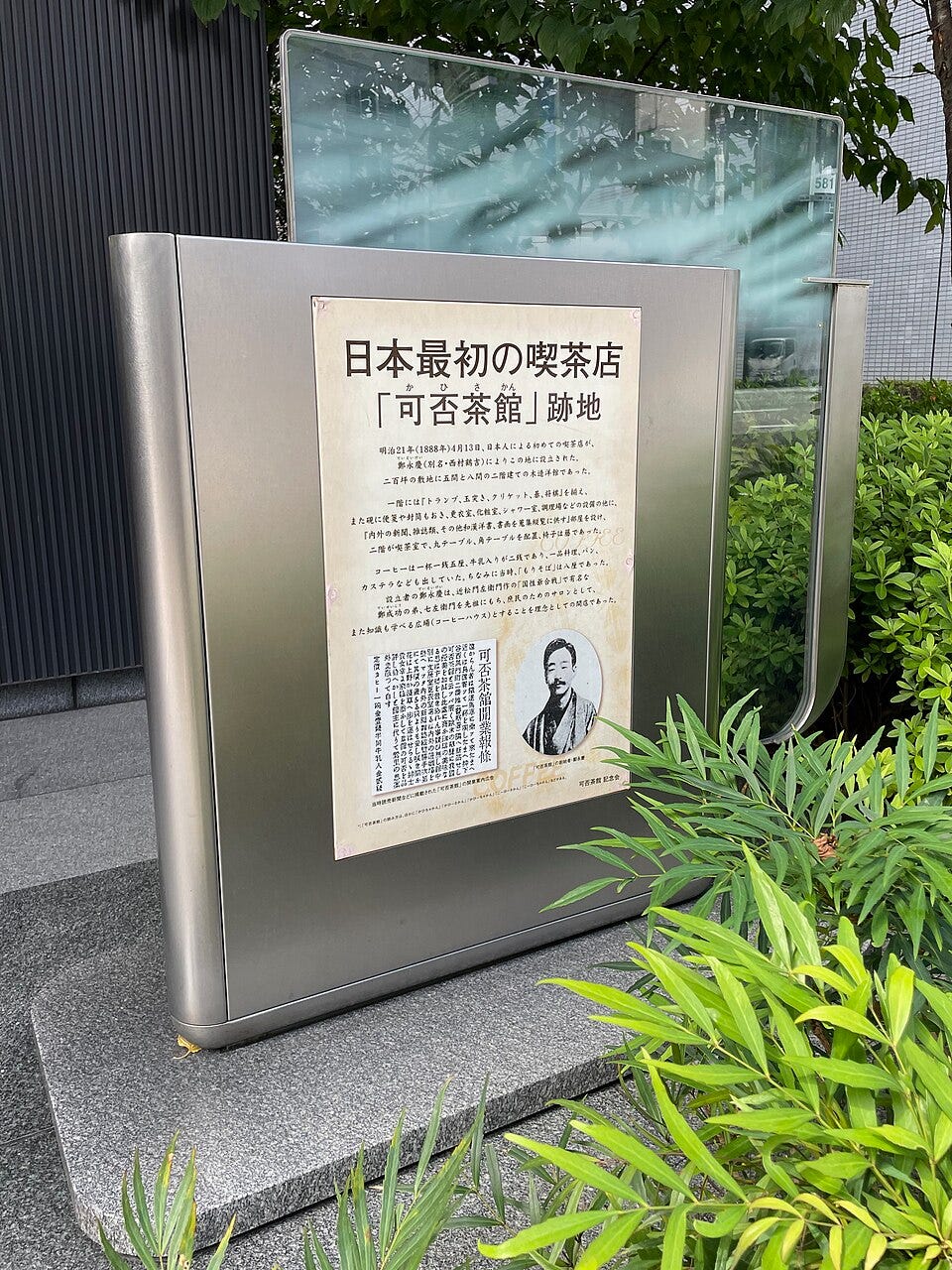
Tei was buried under his birth name Nishimura Tsurukichi in Seattle’s Lakeview Cemetery. One enthusiastic historian notes that his gravestone is “visited by Japanese coffee aficionados and Japanese coffee industry leaders.” Meanwhile, in Ueno, there is a memorial to Tei Ei-kei and the coffee shop of his dreams, Kahiichakan.

Sad for Tei, but you can wash that sad taste from your mouth with some successful coffeeshop owners here:
The World’s First Coffee Chain, Visited by Einstein and Lennon

In the Ginza district of Tokyo, there’s a popular coffee shop called Café Paulista. John Lennon and Yoko Ono visited it in 1978. Before this particular shop was opened in 1970, Café Paulista was a chain of coffee houses visited by some famous people, including Albert Einstein.
References
White, Merry I. Coffee Life in Japan. University of California Press, 2012.
Seidensticker, Edward. Low City, High City: Tokyo from Edo to the Earthquake. Penguin, 1985.
Seidensticker, Edward. Tokyo Rising: The City Since the Great Earthquake. Harvard UP, 1991.
Sakai, Motoshi (坂井 素思). “Consumption of Coffee and Japanese Taste.” (“コーヒー消費と日本人の嗜好趣味”) Journal of the Open University of Japan, No. 25, 2007, pp. 33-40. (In Japanese.)
Whelan, Christal. Kansai Cool. Tuttle, 2014, pp. 100–104.