

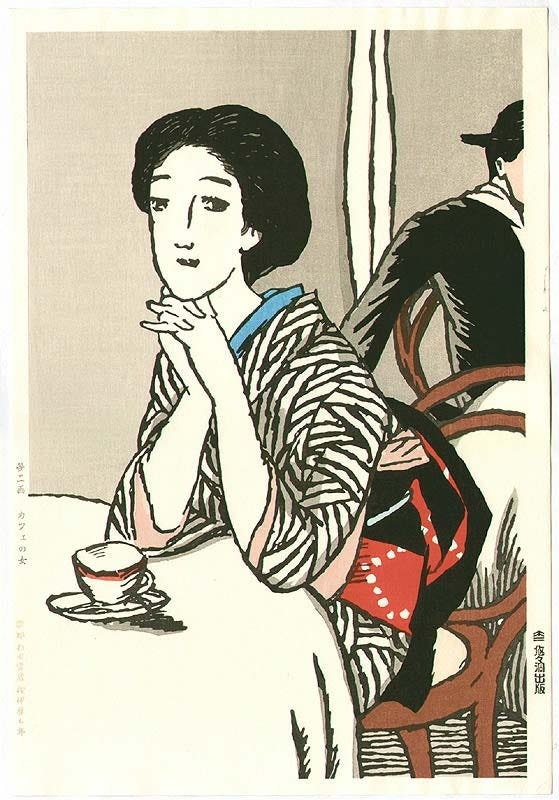
In the 1600s and 1700s, European powers were happily out pillaging the world, treating different-looking humans like cattle, and trading uncouth quantities of gold for strangely pungent plants. Meanwhile in Japan, due to some spoilsport Portuguese Jesuits (long story), trade with the rest of the world was restricted and the country was not yet overrun by 7-Eleven, Pizza Hut, and Starbucks. The Japanese were busy sitting at home playing with shells, putting out a fine blaze every two weeks or so, and perfectly comfortable in their belief that a Frappuccino was a Pokémon.
The only European barbarians still allowed to trade in Japan were the Dutch (whom the slightly colorblind Japanese always described as “red-haired”). In the early Edo period (1603–1868), they started offering a disgusting burnt bean drink for trade. Some adventurous Japanese souls tried the vile concoction.
The best known and most amusing description is from Ōta Nanpo 大田 南畝, an Edo-era poet. In 1804 he took a job with the Nagasaki Magistrate’s office and had a chance to visit the Dutch trading ships. He had this to say about the hospitality of his hosts:
On the Red-Haired Ship, they recommended something called kauhi. It’s made by roasting beans until they’re black, grinding them into powder, and mixing them with white sugar. It has a burnt smell, and the taste is unbearable.
The Dutch reaction to nattō has been lost to time but was probably similar.
Japanese appreciation of coffee didn’t increase tremendously in the next half century. Probably it was mostly used as medicine. In 1853–54, however, an obnoxiously loud and ungentlemanly heavily armed American came knocking and demanded that Japan start trading with the United States. The Shogunate, likely fed up with the disgusting bean water the Dutch kept serving them, was convinced by the polite request made via warships.
Over the next few years, Japan made treaties with other foreign powers, and all sorts of barbarians started coming to the country, trading their wares and bringing their weird burnt-bean-drinking customs. By 1864 there was a café called Victoria Coffee House in the foreign settlement in the port of Yokohama, but coffee was still a strange novelty unknown to most Japanese, the type of thing your cousin who studied abroad wouldn’t shut up about.
In 1867, the politician and businessman Shibusawa Eiichi 渋沢 栄一 was served coffee by some French barbarians. He was a lot less critical than Ōta:
After the meal, they served us coffee, which is water made from boiled beans. I mixed it with sugar and milk and drank it. It left me feeling extremely refreshed.
Around the same time, there was a tea shop and export firm in Kobe called Hokodo. They brought back some coffee beans and started selling coffee. It seems by this time, coffee had gained some traction. The shop still exists today and calls itself the oldest coffee shop in Japan.
But is it?! Tune in next time to find out.
References
White, Merry I. Coffee Life in Japan. University of California Press, 2012.
Seidensticker, Edward. Low City, High City: Tokyo from Edo to the Earthquake. Penguin, 1985.
Seidensticker, Edward. Tokyo Rising: The City Since the Great Earthquake. Harvard UP, 1991.
Sakai, Motoshi (坂井 素思). “Consumption of Coffee and Japanese Taste.” (“コーヒー消費と日本人の嗜好趣味”) Journal of the Open University of Japan, No. 25, 2007, pp. 33-40. (In Japanese.)
Whelan, Christal. Kansai Cool. Tuttle, 2014, pp. 100–104.
And they've come a long, long way since then.