

Why does the sea taste like ramen broth? And how did Vikings give us anime?
Once upon a time, there were two brothers. The younger brother spent his life helping others, giving away his meager possessions, and generally being a nuisance by making everyone else look bad. The older brother maintained the karmic balance by being greedy and mean. Lucky for us, these personalities guaranteed they’d star in their own fairy tale.
One New Year’s Eve, the younger brother had no rice left to make an offering to the gods. When he asked his sibling for some rice, he got a hot, steaming lecture on not giving your hard-earned rice away.
The poor brother left, his stomach empty, as well as his spirit. He ran into a completely unmysterious old man whom he told all his woes, at length. The old man nodded sagely and gave him a manjū 饅頭 (a sweet steamed dumpling) and some advice: “Go find the gnomes who live in the forest and give them this manjū. Insist that they trade you their stone handmill for it. It will solve all your problems.”
The younger brother went off into the woods and found the gnomes who were very excited when they spotted the manjū and offered all sorts of items in trade. The man held fast and insisted on a stone handmill until they finally agreed.
The gnomes said: “This is a special handmill, and it’ll make anything you wish. Simply say what you want, then turn the mill to the right. When you have enough, turn it to the left to stop it making more.”
The man was skeptical (such a device could simply produce infinite manjū, so why trade it for any finite number of manjū, let alone a single one? Because folktale).
Satisfied with his unequal trade, the man took the handmill home. He made himself rice for the New Year’s offering and some new clothes. While he was at it, he made a mansion, a barn, and a few warehouses.
The older brother’s eyes nearly popped out of their stingy sockets when he saw his poor brother strutting around in a fine kimono. Also, where did all this instantaneous architecture come from?!
That afternoon, the older brother peeked into his sibling’s suspiciously new window and saw him use the mill. Big brother immediately snuck off again, unfortunately before seeing the crucial part: how to stop the mill.
That night, he waited for the younger brother to fall asleep, then stole the handmill. He got on a boat and rowed out into the enormous lake surrounding Japan to try his new toy in privacy.
He decided to wish for salt, as it was expensive and would make him a rich man. “Salt!” he cried, and turned the mill to the right. Salt poured forth, gleaming and aplenty like the coins he would trade it for. Quite aplenty. Too aplenty.
Soon, the boat was loaded with salt, but the mill kept on producing. The man tried everything he could think of, but he wasn’t terribly bright so lefty-stoppy didn’t occur to him. Overwhelmed by salt and greed, the boat sank to the bottom of the sea. The handmill is still there to this day, and until someone thinks to go down and crank it to the left it’ll continue making salt grain by grain, century after century.
And that’s why the sea is salty.
The earliest Japanese versions of this tale are just over 100 years old, but the story is much older than that. Stolen-magical-item-bites-thief-in-the-butt stories existed in Asia for centuries, but the handmill making the sea salty appears to have come from Europe.
An old Norwegian folktale, Kvernen som maler på havsens bunn (“The handmill that grinds at the bottom of the sea”), was published in a collection of Norwegian folktales in 1852, and translated into English soon after. It’s likely that the story was brought to Japan by sailors during the late 19th or early 20th century.
So about those Vikings, then...I lied a little (we call it “clickbait” in the trade). The Viking Age ended around 1100, and the earliest known manuscripts for a Norse story about a magical grinding mill are from the Gróttasǫngr in the 1200s. So Viking-ish.
The gnomes (in Japanese kobito 小人, literally “little people”) don’t appear in the Norse sources and may be a Japanese addition. Gnomes and dwarfs are pretty common in the stories of many cultures. There’s evidence of a Russian version of the story told in Japan in 1923 which involved a gnome, but there are also many native Japanese stories with gnomes.
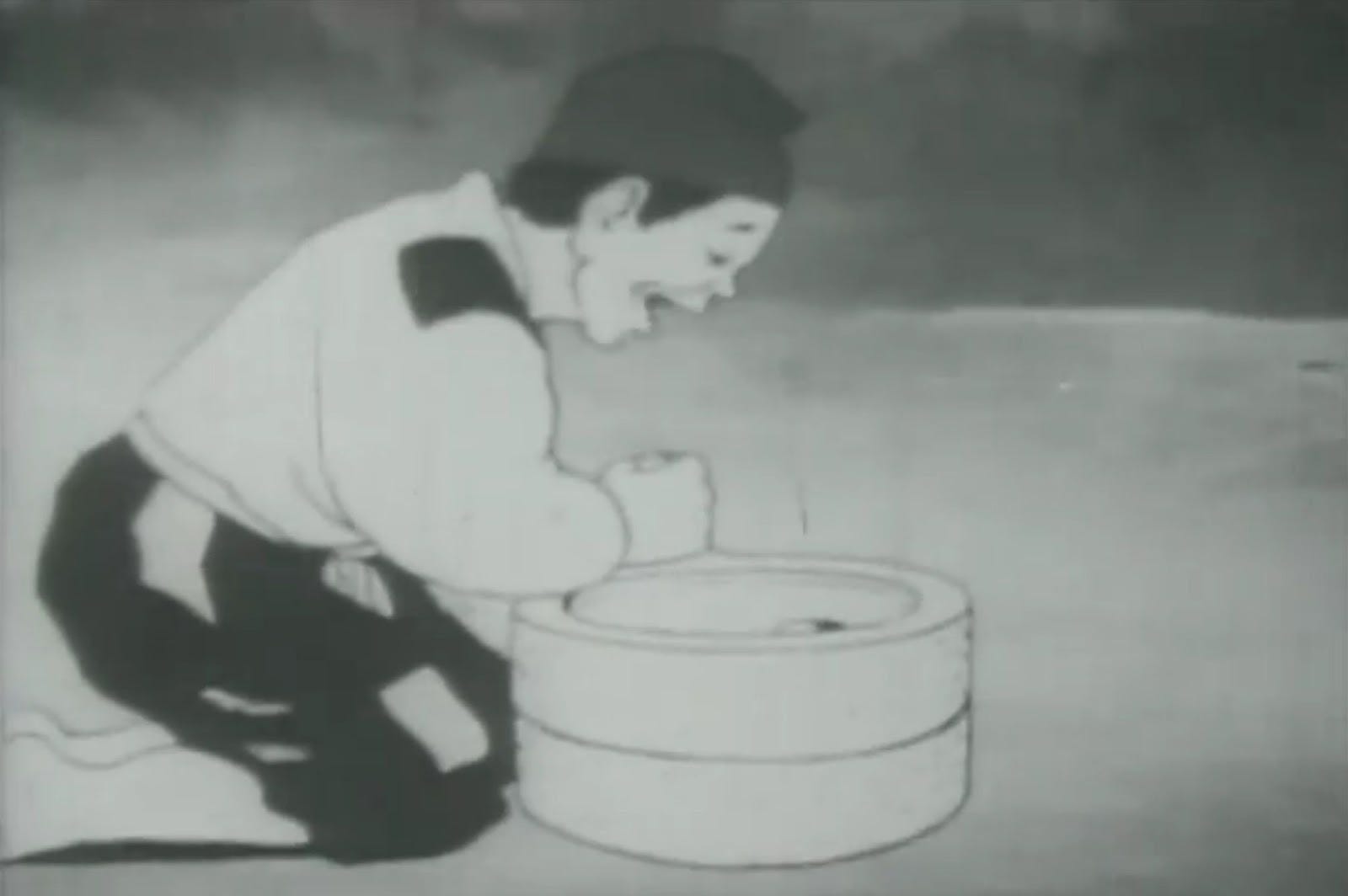
Because toy companies hadn’t invented collectible card games and tie-in merchandising yet, early anime was often based on folktales. One such relic is the silent 1935 short “Why the water of the sea is salty” 海の水はなぜからい which you can watch here:
You can’t get enough of stories about wicked characters choking on their karma, like this one about a man who thought he could trick his wife.
References
Mayer, Fanny Hagin (trans.) & Yanagita Kunio. “Yanagita Kunio: Japanese folk tales,” Folklore Studies, Vol. 11, No. 1, 1952, pp. 65–68. http://www.jstor.org/stable/1177324
Mayer, Fanny Hagin & Kunio, Yanagita. The Yanagita Kunio Guide to the Japanese Folk Tale. Indiana UP, 1986, p. 91.
Seki, Keigo. “Types of Japanese Folktales,” Asian Folklore Studies, 25, 1966, p. 92 (Tale 173) https://doi.org/10.2307/1177478
Seki, Keigo. Folktales of Japan. U of Chicago Press, 1963, pp. 134–138. https://archive.org/details/folktalesofjapan00seki/page/134/mode/2up
https://www.nishikata-eiga.com/2013/12/why-is-sea-water-salty-1935.html
https://talesfromtheenchantedforest.com/2023/01/01/why-the-sea-is-salt/
Heck ya! Really interesting story and it was funny, as I was reading it I was thinking “this sounds oddly European for a folktale” and then sure enough!
It makes sense then why it wasn’t part of the stories that I read in “Japanese Fairy Tales, by Yei Theodora Ozaki” but that is a cool origin for the sea being salty.