

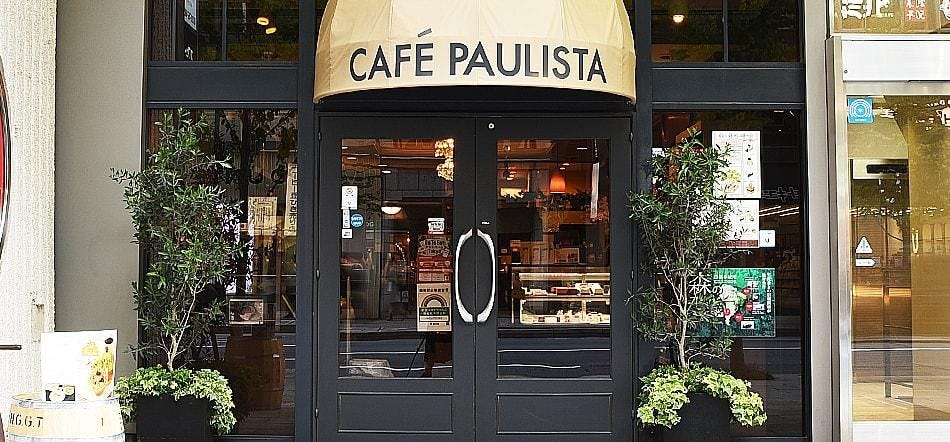
In the Ginza district of Tokyo, there’s a popular coffee shop called Café Paulista. John Lennon and Yoko Ono visited it in 1978. Before this particular shop was opened in 1970, Café Paulista was a chain of coffee houses visited by some famous people, including Albert Einstein.
You can already tell by the name that it has an interesting history. Paulista is a term for someone from São Paulo, Brazil, yet the whole coffee chain was started in 1911 (probably) by a Japanese man. What did a Japanese guy from the early 1900s have to do with Brazil? A lot.
The last story was about a failed coffeeshop owner. Hopefully this time things go well.
Japan runs out of jobs
By the 1880s, twenty years of “Enrich the Country, Strengthen the Armed Forces” (富国強兵, fukoku kyōhei) had left the Japanese economy with all the enrichment of a packet of ramen. Rice prices fell, leaving farmers unable to pay their taxes.
With the government’s push for industrialization many of these farmers moved to cities to look for work, which they succeeded in doing. They successfully looked for work, however, they were not very successful in finding it. Things only got worse when, in 1895 and 1905, soldiers returned home from fighting China and Russia, with medals on their chests but no employers on their doorsteps.
The government’s clever solution was to send people outside the country. In 1885 the first group of emigrants left for Hawaiʻi to work on the sugar plantations. Japanese immigrants to Hawaiʻi and California replaced the Chinese laborers that had been expelled by the US’s 1882 Chinese Exclusion Act. But after a while the US realized there was a bit too much inclusion in the country, and negotiated with Japan the Gentlemen’s Agreement of 1907, a name so polite it stabbed you in the back. The result: Japanese immigration to the US halted.
Japan redirected its emigration policy to South America, so let’s see what’s been going on over there...
Brazil picks coffee
Coffee arrived in Brazil in 1727 by way of the Dutch and French. The first workers on coffee plantations were indigenous slaves, but that didn’t work too well because the slaves managed to escape their lives of exploitative, backbreaking labor by dying to European diseases. The plantation owners’ warmhearted response was to grumble about lost profits and ship over slaves from Africa.
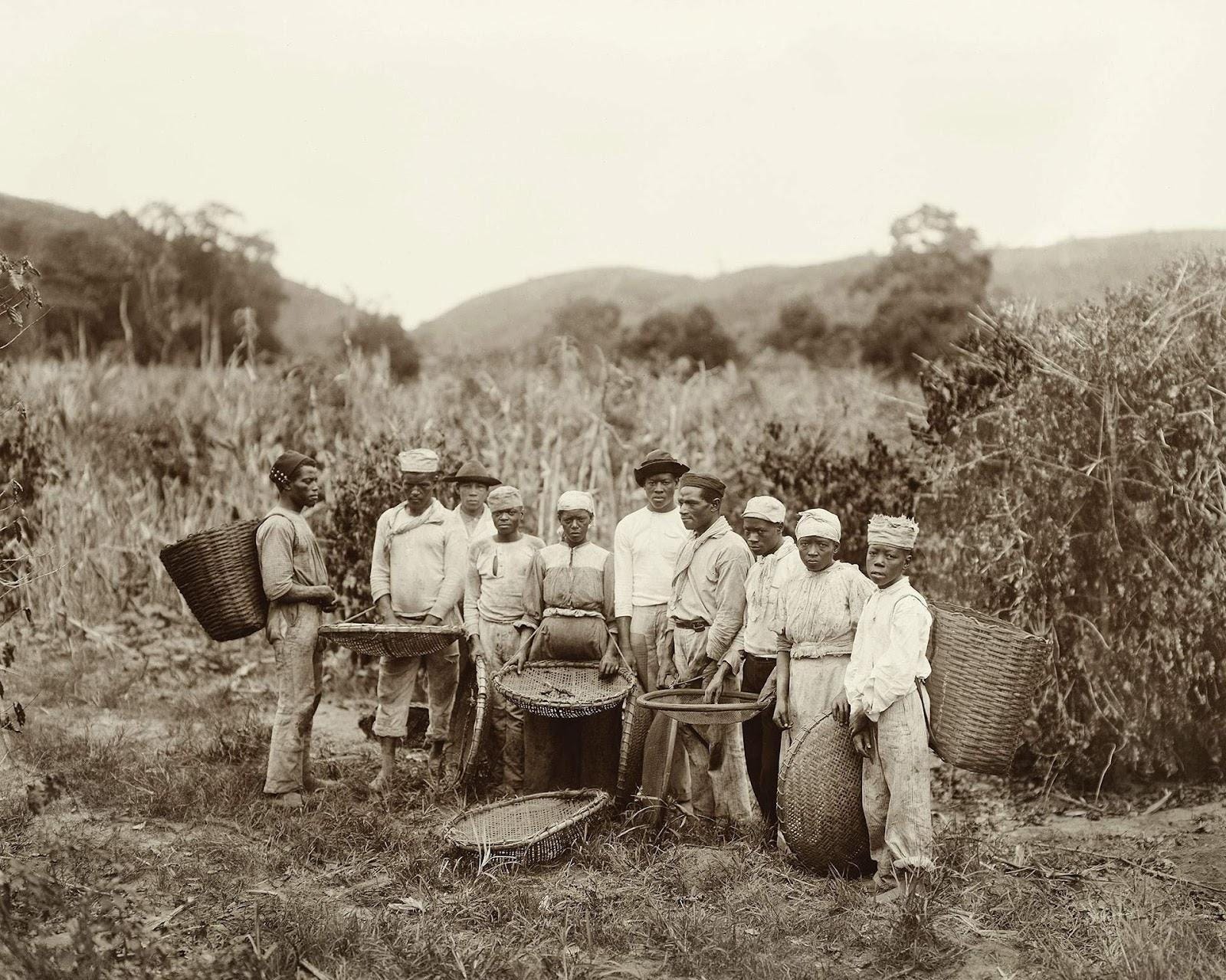
Everything was fine until the 1880s, when progressive rabble-rousers started talking about human rights and other such inconveniences. To keep their fertile profits, plantation owners imported poor immigrants from Europe.
Seeing the writing on the wall, in 1887 the Brazilian government started sponsoring immigration, paying for people’s travel and promising them jobs. It was like the world’s first timeshare vacation home scam: “Come enjoy a year of profitable work on our wonderfully relaxing plantations before returning home a rich (wo)man!” Except for the rich part. Or the relaxing part. Or the returning home part.
Finally in 1888 the Golden Law (Lei Áurea) abolished slavery completely, and all workers were supposedly salaried and free. Free to toil under slavery-like conditions.
Many of the new immigrants came from Italy, but when news of the working conditions made it back to Rome, people there were molto displeased. Sponsored immigration was outlawed through the 1902 Prinetti decree. Uh-oh. Now where do we get our sla...contract workers?
Japan enters the chat
Actually, Japan had tried to enter the chat in 1894 and 1901, but had been kicked out by overly protective mods. Brazilian politicians shared enlightened rhetoric which can be kindly paraphrased as “Japanese are a backwards and inferior race and we don’t want them to mingle with us.”
By 1906, even the hardcore xenophobic nationalists were starting to sweat, though. Brazil had brewed itself into an awkward blend: coffee was by far its biggest export, but prices were threatening to plummet due to overproduction. They needed new overseas markets, but at the same time they needed more labor to keep up the overproduction! The wheels of coffee capitalism were threatening to grind everything into dust—or very fine grounds.
With the 1906 Taubaté Agreement, the governments of several Brazilian states agreed to bail out the pitiably rich plantation owners by guaranteeing to buy any leftover beans from growers. Having a ton of useless beans on their hands, the government now really, REALLY wanted to solve this whole coffee situation.
That same year, Japanese businessman Mizuno Ryo 水野龍 came across the Andes. Depending on the source, and on your level of romanticism, he came on foot or riding a mule. I rather like mules. He muled across the Andes. In any case, it was quite the trek. Mizuno managed to hammer out some agreements and set up an immigration service for migrant farmers from Japan to São Paulo. For the Brazilians, this meant both people to work their fields, and a potential new market in Japan.
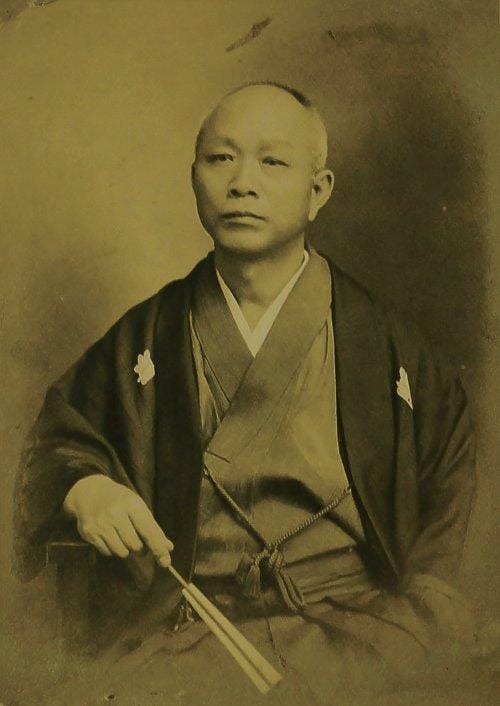
Back in Japan, Mizuno recruited younger brothers from rural families (who wouldn’t inherit the land, and were thus “free labor”). Plantation owners wanted stability, so contracts required families of three to ten people, ages 12 to 45. Some Japanese, being already familiar with origami, formed “paper” families, just faking it to get the jobs.
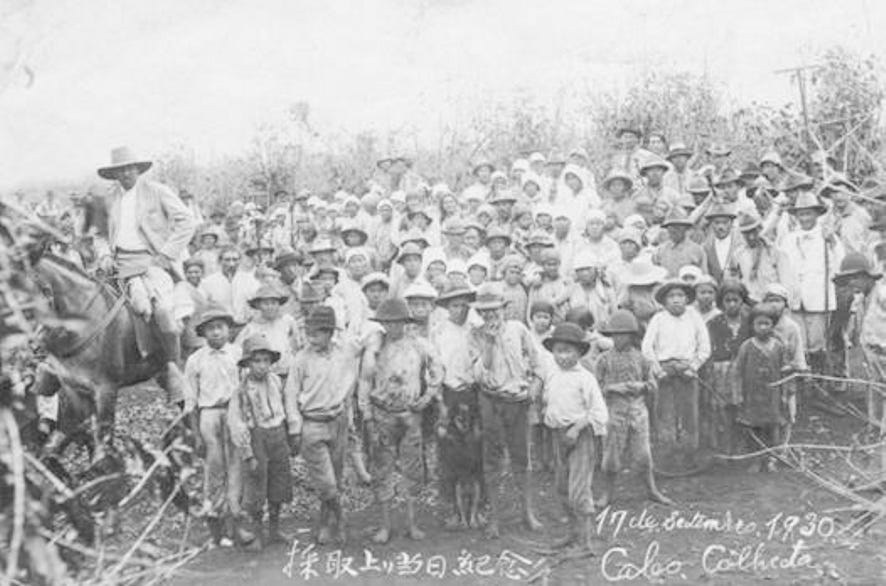
In 1908 the ship Kasato Maru delivered the first 781 immigrants from Japan. Apparently on inspection of the ship, the Brazilians were surprised by how clean this “inferior race” had left the kitchen, bunkrooms, and bathrooms. Meanwhile, the Japanese were less impressed by the conditions on the plantations.
Mizuno’s beans
Aside from his payments, Mizuno was given a bunch of coffee beans. This sounds like Dumbo being paid in peanuts, but in fact, he received a hilariously huge amount of coffee: nearly a quarter of all the coffee entering Japan between 1915 and 1923 were Mizuno’s beans! Only one thing to do now. He opened Café Paulista in Ginza, probably in 1911.
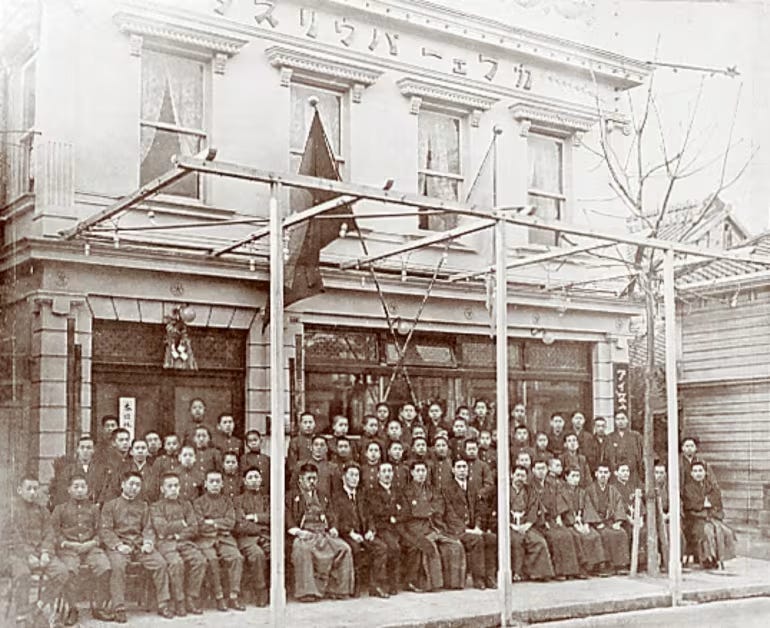
The shop had mirrored walls, glittering chandeliers, gilded furniture, a piano, young male waiters in Brazilian naval uniforms, and the amazingly bad-ass slogan:
鬼の如く黒く、恋の如く甘く、地獄の如く熱きコーヒー
Coffee as black as an oni, as sweet as love, as hot as hell
The slogan was a paraphrase of French diplomat Charles Maurice de Talleyrand-Périgord’s claim about the ideal cup of coffee:
Noir comme le diable, chaud comme l’enfer, pur comme un ange, doux comme l’amour
Black as the Devil, hot as hell, pure as an angel, sweet as love
A cup of coffee cost just 5 sen (5 hundredths of a yen), a sixth the price of a cup at other cafés. A Brazilian doughnut (malasada) cost another 5 sen. One of Paulista’s innovations was to offer sugar for free, making the bitter bean juice more palatable.
Just like at Kahiichakan, customers could linger as long as they wished. However, unlike Kahiichakan, Café Paulista received its beans for free, and didn’t offer newspapers, tobacco, or baths to its customers. So while Tei-kei’s business failed, Mizuno’s became wildly successful, though filled with grimier guests.
More than 2,000 customers a day visited the Ginza store and soon there were more than twenty Café Paulistas in Kantō and Kansai. It was possibly the first coffee chain in the world.
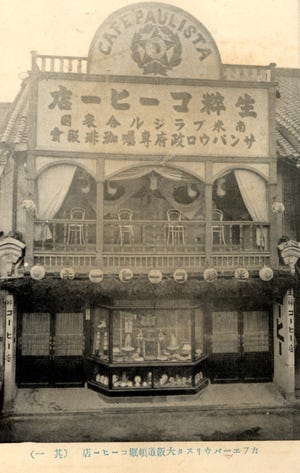
The café could be rented for events like weddings, and sometimes even showed movies. Like coffee houses everywhere, it was popular with writers. It was featured in literary and critical texts and hosted publication parties and poetry readings.
In the early 1920s the Ginza location was sometimes called the “hangout for bums.” Usually by people who didn’t like poetry readings or fun.
The original shop was destroyed in the 1923 Kantō earthquake. The company started focusing on importing and exporting coffee, and closed its other stores one by one until none were left. Only decades later in 1970 did they open a new Ginza shop. There’s a plaque by the booth where John Lennon and Yoko Ono sat.
We’re not done with coffee yet. Next time we’ll explore the first cat cafes 😻.
Japan's Café Era and the First Cat Cafés

While Mizuno Ryo’s Café Paulista was slamming down the hammer of big caffeine capitalist chain conformity, plenty of hipster independent coffeehouses popped up in early 20th century Tokyo. Let’s explore three of the most famous: Puran…
References
White, Merry I. Coffee Life in Japan. University of California Press, 2012.
Seidensticker, Edward. Low City, High City: Tokyo from Edo to the Earthquake. Penguin, 1985.
Seidensticker, Edward. Tokyo Rising: The City Since the Great Earthquake. Harvard UP, 1991.
Sakai, Motoshi (坂井 素思). “Consumption of Coffee and Japanese Taste.” (“コーヒー消費と日本人の嗜好趣味”) Journal of the Open University of Japan, No. 25, 2007, pp. 33-40. (In Japanese.)
Whelan, Christal. Kansai Cool. Tuttle, 2014, pp. 100–104.
Uehara, Alexandre Ratsuo. “Nikkei Presence in Brazil: Integration and Assimilation” in Cultural exchange between Brazil and Japan : immigration, history, and language, International Research Center for Japanese Studies, Kyoto, 2009, pp. 141–154. https://doi.org/10.15055/00001405
Yamawaki, Keizo. “Foreign workers in Japan: a historical perspective” in Japan and Global Migration: Foreign workers and the advent of a multicultural society, edited by Mike Douglas & Glenda S. Roberts, Routledge, 2000, pp. 124–126.